Giving Feedback and Receiving It Are Two Different Skills. Both Can Be Taught.

Post-observation feedback works or fails on one disciplined sentence: name what you actually observed in professional language rather than judgment, then stop talking. The sequence that follows matters too. State genuine positive intent, offer a specific example, name the impact, make a clear request, and invite the teacher to respond. The harder half of the exchange happens on the receiving side, and that half is a skill a school can build.
Giving feedback and receiving it are two separate capacities, each with its own skill set, and each learnable. That framing comes from Jennifer Abrams, a communications consultant and the author of Having Hard Conversations, writing for Learning Forward in August 2026. She calls them “saying the hard thing” and “hearing the hard thing.”
What Makes Post-Observation Feedback Land or Bounce?
The observation is the most frequent coaching moment a school leader has. What determines its return is not the walkthrough itself but the conversation that follows, and Abrams argues that conversation runs on a skill the profession does not formally teach. Her summary: “Most educators were never actually taught how to do either one well.”
That is worth a leader’s attention because the feedback conversation is where administrative support either becomes concrete or stays abstract. The Learning Policy Institute’s report Teacher Turnover: Why It Matters and What We Can Do About It (Carver-Thomas and Darling-Hammond, 2017) names a lack of administrative support among the key influences on teacher turnover. Support is not a feeling teachers absorb from a building. It arrives in specific exchanges, and post-observation feedback is the most regular one on the calendar.
A gap in training is a solvable kind of gap. Communication skill is teachable to adults, and teaching it does not require a budget line.
Why Doesn’t More Feedback Automatically Mean Better Feedback?
The standard response to weak feedback is to produce more of it, faster. Observe more often. Shorten the turnaround between the visit and the write-up. Both are right, and the second is a real constraint worth solving: we have written separately about how principals compress the post-walkthrough write-up from hours to minutes.
Speed and volume change how much feedback a teacher receives. Neither changes whether any of it lands. A conversation that opens with a verdict still opens with a verdict when it arrives the same afternoon instead of nine days later, and running it a dozen times a year instead of twice multiplies whatever the conversation already was.
How Do You Give Feedback to Teachers After an Observation?
Abrams offers a scaffold she uses with leaders, and it runs in a fixed order: open with genuine positive intent, frame the issue in professional rather than personal language, offer a specific example, clarify the impact on others, make a clear request for action, and then invite the other person into dialogue. Her warning is that the order is not decorative. Drop a step, particularly the first one, and everything after it gets harder.

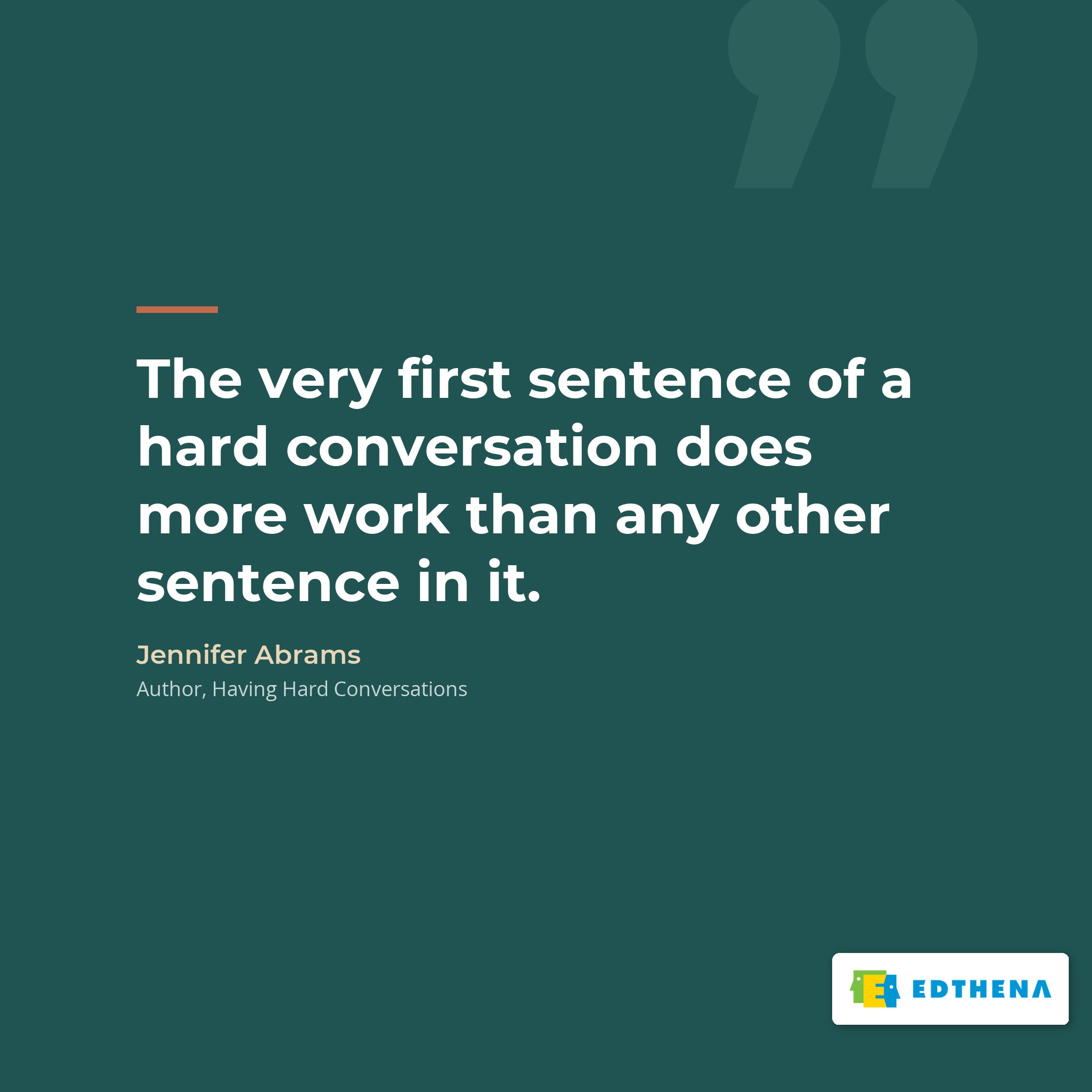
The opening line carries the most weight. “The very first sentence of a hard conversation does more work than any other sentence in it,” Abrams writes, and her example of getting it wrong will be familiar. Say “your class is chaotic” or “you’re being difficult” and, in her words, “you’ve handed the listener a verdict on their character, not a description of a behavior.” The teacher then spends the rest of the meeting defending themselves rather than listening.
Two practical constraints follow from the scaffold.
- Stick to what you observed. Abrams draws a hard line here: if you did not see or hear it directly, you do not have a hard conversation yet; you have an investigatory one, and that is a different conversation with different rules. For anyone running walkthroughs, this separates feedback from hearsay.
- Say less, then sit in silence. Her most common criticism of well-intentioned leaders is that they soften a clear message under six more sentences of context, reassurance, and apology. “Silence after a clear statement is uncomfortable,” she writes. “It’s also where the real conversation begins.”
Why Is Receiving Feedback a Skill Rather Than a Personality Trait?
“Many educators are taught extensively how to give feedback,” Abrams notes. “Far fewer are ever taught how to receive it.” Her position is that the ability to receive feedback well “is not a fixed personality trait” but a professional capacity that develops through practice.
The central move she names is suspending certainty: holding your own opinion or decision in an undecided state long enough to take in new information before reacting to it. She illustrates it with the old story of the student whose cup is already full; nothing more can be poured in. The practical version is asking “What am I missing?” instead of explaining why you were right. She adds an uncomfortable calibration: the person giving you feedback is “very often at least 10 percent right, even when the rest of what they said missed the mark.” Her question for the receiver is whether you can sit with that 10 percent instead of arguing the other 90.
For a leader, that reclassifies a familiar problem. When a teacher meets routine, gently delivered feedback with tears, withdrawal, or defensiveness, the instinct is to judge the reaction. Abrams points out that feedback does not land identically for everyone, and that for some people it registers as threat rather than information. Judging that response does less than building the skill underneath it, and the tools are small enough to teach in a staff meeting. Two deep breaths. A sentence that buys time, such as “This feedback stings, let me sit with it before I respond.” And a standing reminder that feedback is input, not something set in concrete.
How Do You Build Feedback Capacity on Both Sides?
Abrams names three conditions for building feedback tolerance in the people you lead. Normalize feedback as a routine part of a growth-oriented culture. Model how you personally receive it. Give people language to use in the moment they start to feel defensive.
One condition Abrams’s article does not address is cadence, and this next part is our position rather than hers. Feedback skill behaves like any other practiced skill, so the training conditions matter as much as the content. Three things make the reps productive: frequency, so no single conversation carries unusual weight; low stakes, so the exchange is separable from evaluation; and specificity, so there is an actual behavior to work on rather than an impression to dispute. The application to observation cycles is ours as well.
Two places where that cadence already exists are worth checking first. Induction programs for new teachers have built-in frequency and a developmental purpose, which makes them the natural place to teach the receiving side. PLC time puts feedback between peers rather than across a supervisory line, which lowers the stakes without scheduling a workshop.
Technology helps on each side in different ways. Observation Copilot works on the giving side, turning what a principal noticed during a walkthrough into specific, framework-aligned feedback quickly enough that the time goes into the wording rather than the write-up. The principal still writes the feedback; what changes is that the opening sentence gets a second look. AI Coach works on the receiving side: a coaching layer for teachers, delivered virtually, where a teacher runs a full reflective coaching cycle on their own practice and their own schedule. Because the work is private, the teacher gets reps at hearing something about their teaching and acting on it without an audience. Both are supplements to human coaching rather than replacements for it.
Where to Start in Your Next Observation Cycle
Change one habit before anything else. Write your opening sentence down before the conversation and check it for a verdict on the person. If it describes a behavior you observed, it is ready. If it characterizes the teacher, rewrite it. That one habit is the giving-side scaffold in miniature.
The receiving side you model rather than assign. Ask two teachers for feedback on something you run, take it without defending yourself, and name the 10 percent you think they got right. It costs one meeting and teaches more than a session on the topic would.
Improving feedback is one of the few coaching investments that costs no new headcount, because what gets upgraded is a conversation you are already having. See how Observation Copilot supports faster, more specific post-observation feedback, or learn how AI Coach gives every teacher a coaching cycle to work.
Frequently Asked Questions
How should a principal open a feedback conversation after an observation?
Open with genuine positive intent, then name the issue in professional language rather than judgment. Describe the behavior you observed instead of characterizing the teacher. Abrams’s sequence continues with a specific example, the impact on others, a clear request, and an invitation to dialogue. Skipping the opening move makes the rest harder.
What is the difference between a hard conversation and an investigatory one?
Abrams draws the line at direct observation. If you saw or heard the behavior yourself, you can hold a hard conversation about it. If you are working from a report, a rumor, or a pattern someone else described, you have an investigatory conversation first, and it follows different rules.
Can you actually teach someone to receive feedback better?
Yes. Abrams argues that the ability to receive feedback well is a professional capacity rather than a fixed personality trait, and that it develops through practice. The tools are practical: two deep breaths, asking for a moment before responding, and treating feedback as input rather than a permanent verdict.
How often should teachers get feedback from classroom observations?
Often enough that no single conversation carries unusual weight. Short, frequent, specific feedback gives both sides reps, while feedback that is rare and tied to evaluation raises the stakes of every sentence. This is our read on cadence rather than a finding from Abrams’s article.
What should you do when a teacher reacts badly to routine feedback?
Treat the reaction as a skill to build rather than a character flaw to judge. Abrams notes that feedback registers as threat rather than information for some people. Give the teacher language to use in the moment, model how you take feedback yourself, and keep the cadence steady so feedback stops being an event.