How One District Turned Middle School Math Data Into a Weekly PLC Cadence

In Indianapolis, the Metropolitan School District of Washington Township has made using assessment data in PLCs a weekly routine. Middle school math students take two weekly assessments created at the instructional coaching level for all three middle schools, and teachers bring the results to weekly professional learning community (PLC) meetings to ask whether they developed each concept thoroughly enough. Kaitlin Fields, the district’s secondary math instructional coach, described the approach in eSchool News.
Her opening example, which she calls a real-life one, is a single meeting of middle school math teachers. A team’s eighth graders “keep missing the same assessment question about graphing a system equation,” and the teachers set out to find out why. As they talk through the results, it becomes clear that students “may be missing a foundational concept like what a solution means.” The question the team asks, in Fields’ words, is whether they “developed concepts thoroughly enough, based on students’ day-to-day assessment results.”
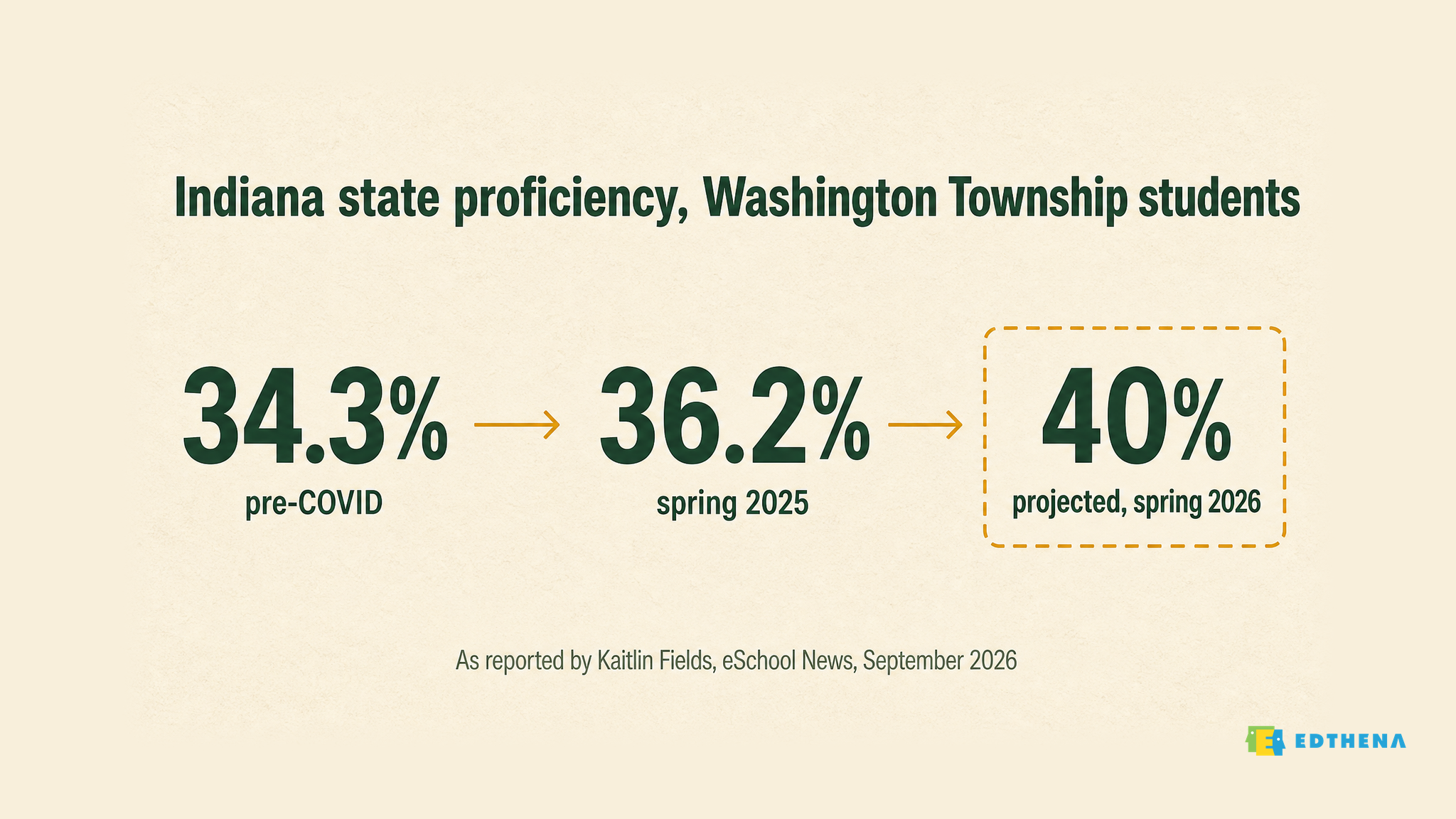
Fields reports that Washington Township students’ scores on the Indiana state proficiency exams rose to 36.2 percent in spring 2025, above the pre-COVID rate of 34.3 percent, with a projected 40 percent for spring 2026 based on three checkpoints during the year. For a principal or math director who owns PLC time and data use, the useful part of her account is the routine behind those numbers.
What Did Washington Township Change About Its Math Data?
Fields starts from the limits of collecting data. “In recent years, schools have mastered data collection,” she writes. “But just gathering, storing, and comparing information is not sufficient.” In 2024, the district’s middle school math team began using a data platform, and the switch prompted teachers to scrutinize the progress data they were collecting.
The result was a regular, shared set of evidence. Middle school math students now take two weekly assessments, “created at the instructional coaching level to ensure continuity in core math courses across all three schools.” Because the assessments are common, PLCs in every building can start from the same evidence.
The bigger change was how the team treats the results. “Scores are no longer viewed as an evaluative tool but rather as a structured starting point for meaningful conversations about teaching and learning,” Fields writes. She adds that “these conversations can be difficult, but they are essential for improving students’ understanding and mastery.”
The work spans 29 teachers in three middle school math departments. After two years of building trusting relationships, Fields writes, “we have reached a point where we operate as one unit across buildings.”
What Happens in a Weekly PLC Data Conversation?
Instead of placing the burden on students to input the correct answer, teachers ask whether they developed the concept thoroughly enough.
The assessments themselves are built to make that conversation specific. Fields describes building teachers’ skill at writing standards-based assessments that pinpoint misconceptions: “with multiple-choice exams, answers B and C would highlight different errors that need to be addressed through reteaching or one-on-one instruction.” A wrong answer becomes a clue about which idea did not land. This is the same shift we describe in our guide to effective PLC meetings: analyzing student errors, not just scores.
Fields describes two instructional changes the data supported. She writes that the data helped the team build a year-long picture of spiraling, which she defines as systematically revisiting previously learned content to improve retention and recall. And the weekly formative data, she writes, “helped motivate us to develop common pacing guidelines across all three middle schools.” She also credits clearer sight of what content is taught, and why, with more rigor in classrooms, and notes that higher teacher expectations led students to ask deeper questions.
Four Moves Leaders Can Copy From Washington Township
Fields describes her district’s practice, not a protocol. The four moves below are our read of what a school or district leader can take from her account and apply to their own math PLCs.
1. Build the common assessments at the coaching level
Washington Township creates its two weekly assessments at the instructional coaching level “to ensure continuity in core math courses across all three schools,” and the team is also expanding teachers’ skill at writing standards-based assessments. For a leader, the decisions are who owns the common items, who helps write them, and whether that work has time each week to write, review, and revise.
2. Keep the weekly data conversation non-evaluative
The district treats scores as a starting point for conversation, not a rating of the teacher. Fields also names stability as a source of buy-in: “Knowing the district was not going to keep changing edtech tools created buy-in.” A leader can protect both by keeping weekly PLC results separate from teacher evaluation and by committing to the tools and routines long enough for trust to build.
3. Expect a decision that changes next week’s teaching
Fields ties spiraling to the team’s data platform and common pacing to the formative data collected each week. A useful check after any data meeting is whether the team can name what it will reteach, revisit, or pace differently next week. If the answer is nothing, the team has looked at the data but not yet used it.
4. Connect coaches across departments
The district’s English language arts (ELA) program has adopted the same data platform, and Fields writes, “Their instructional coach and I constantly talk about the results, how they compare to state assessments, and what we can improve.” The math approach is expanding to the high school this fall. Regular coach-to-coach time is a low-cost way to carry what one department learns into another.

What Results Has Washington Township Reported?
In her September 2026 article, Fields reports that Washington Township students’ scores on the Indiana state proficiency exams reached 36.2 percent in spring 2025, above a pre-COVID rate of 34.3 percent, with a projected 40 percent for spring 2026 based on three checkpoints during the year. She writes that the success at the middle school level has led to positive anticipation around bringing the approach to the high school math department starting this fall.
Fields frames the result as a milestone. “There is a strong correlation to their gains in the classroom compared to achievement on state standards exams,” she writes, and she calls surpassing the pre-COVID rate “just one step in our ongoing efforts to improve student outcomes.” Her article is a practitioner’s account rather than a controlled study, and leaders should read the figures as one district’s reported progress alongside a change in how its teams use data.
Fields also points to a result that does not show up in test scores. “Demonstrating success is good,” she writes, “but being able to point to exactly why that success is occurring generates a higher level of trust, respect, and autonomy” from school leaders.
Where Does the PLC Data Conversation Stop, and How Does Coaching Extend It?
A weekly PLC can decide what to reteach. The reteaching then happens in each of the 29 teachers’ classrooms. Fields names the next step her team is exploring: “We are exploring how to use data more in real time in the classroom.” The question a leader faces is how each teacher gets feedback on the move the team agreed to, between one meeting and the next.
Two layers can carry the PLC’s decision into individual practice. The first is classroom observation feedback. Observation Copilot turns a principal’s notes from a walkthrough or formal observation into framework-aligned feedback with strengths and next steps, which the teacher can often receive the same day. Observation Copilot also brings each teacher’s observations together into one picture of how practice is growing across the year.
The second is between-meeting coaching. With AI Coach, a teacher uploads a lesson, gets private feedback in minutes, sets a near-term goal, and builds an action plan to try in class. AI Coach is built to complement human coaches and PLCs, and a teacher can choose a coaching goal connected to what the team decided. We cover that between-meeting gap in more depth in how to make PLCs effective.
Where Should a Leader Start?
Start with one course team. Agree on who writes a short common assessment, protect a weekly slot to discuss it, and open the next meeting with the single item most students missed. Ask the team what their instruction built and what it skipped, then name one change for next week’s lessons.
If you want each teacher to have coaching on that change before the next PLC, see how AI Coach gives every teacher a private coaching conversation and an action plan between PLC meetings.
Frequently Asked Questions
What does using assessment data in PLCs look like week to week?
In Washington Township’s middle school math program in Indianapolis, students take two weekly assessments created at the instructional coaching level, and teachers discuss the results at weekly PLCs, asking whether they developed concepts thoroughly enough. Leaders can ask each team to end the meeting with one decision about what to reteach, revisit, or pace differently.
Who should write the common assessments a PLC discusses?
In Washington Township, the two weekly middle school math assessments are created at the instructional coaching level to keep core courses consistent across three middle schools, and the math team is expanding teachers’ skill at writing standards-based items. The goal is questions whose wrong answers point to specific misconceptions, so a PLC can tell one error from another.
How do you keep PLC data conversations from feeling evaluative?
Washington Township’s math coach, Kaitlin Fields, says scores there are treated as a starting point for conversations about teaching and learning rather than an evaluative tool. Leaders can support that by keeping weekly PLC data separate from teacher evaluation and by keeping tools and routines stable long enough for trust to build.
What results has Washington Township reported?
Kaitlin Fields reports that Washington Township students’ scores on the Indiana state proficiency exams reached 36.2 percent in spring 2025, above the pre-COVID rate of 34.3 percent, with a projected 40 percent for spring 2026. She writes of a strong correlation between classroom gains and state exam achievement, and calls the milestone one step in ongoing work.
Where do classroom observation and coaching fit in a data-driven PLC?
A data-driven PLC decides what to change; observation and coaching help each teacher carry that change into the classroom. Observation feedback shows how a move landed in a lesson, and between-meeting coaching, such as Edthena’s AI Coach, gives each teacher private feedback and an action plan before the next PLC meets.