Edthena and University Partners Win Gates Foundation Grant to Build AI Teaching Simulations for Math Teachers

Neurosurgeons practice on simulated brains. Pilots log hours in simulated aircraft. Teachers, however, mostly get the real thing. A third-grade teacher leading a math discussion for the first time? Their “rehearsal” is in front of 24 actual eight-year-olds, with the clock running and no second chance.
Edthena, together with researchers at University of Virginia, TeachingWorks at University of Michigan, and Boston University, has been awarded a two-year, $750,000 research grant from the Gates Foundation to build and test an AI teaching simulation for elementary math teachers in grades 2 through 5. Teacher-preparation programs have used simulated students for years; this grant lets us try it with working teachers, on the lesson each one is about to teach. The project is called ART of Math, short for AI Rehearsals for Teachers of Mathematics.
The idea is simple to say and hard to build: a teacher rehearses tomorrow’s math discussion out loud with AI-simulated students, teaches it for real the next day, and then sees how the two compare.
What We Are Building
When we are done, a teacher will upload a problem from their own curriculum before teaching it and simulate a short discussion with three to five AI-simulated students who think the way real students do (including with their common misconceptions).
The rehearsal will run about ten minutes, short enough to fit inside a planning period. Afterward the teacher gets ideas for what to change if a similar situation happens during the teaching. The system names the moves they made and offers one thing to try tomorrow.
Then the teacher teaches the real lesson, records it on a phone, and uploads the video to their own private space. A second conversation with the virtual coach compares the rehearsal with the classroom. What carried over? What did they try in practice and skip in front of real kids?
Avatar simulation platforms have, for years, run set scenarios with a trained human operator behind the avatars in scheduled sessions. What is new here is that the rehearsal is the teacher’s own next lesson from their actual curriculum, the rehearsal runs on-demand by voice with no one behind the curtain, and the loop closes with the real classroom.

What a Rehearsal Will Sound Like
Picture a third-grade teacher, Danielle, during her Tuesday planning period. Tomorrow’s warm-up in her curriculum is 48 + 27. She uploads the problem and starts the rehearsal. Three simulated students are waiting: Jayden, Priya, and Marcus.
Danielle poses the problem and asks for a thumbs-up when students have an answer. Then she calls on Jayden.
“I started at 48 and jumped 10 to 58, then 10 more to 68. Then I counted seven more: 69, 70, 71, 72, 73, 74, 75.”
Priya goes next. “I broke both numbers apart: 40 plus 20 is 60. Eight plus seven is 15. Then 60 plus 15 is 75.”
Marcus has been waiting. “Mine is faster. I made 48 into 50 because 50 is friendlier. Then 50 plus 27 is 77.”
There is a few seconds of silence.
That silence is the whole point of the rehearsal. Marcus has used “compensation,” a strategy more advanced than the other two, and he has made the slip compensation invites: he borrowed two to make 50 and never gave them back. In a real classroom, with 23 other kids and the clock running, a teacher might say “close but not right” and move on. Danielle has room to try something else.
“Priya, can you say back what Marcus did, in your own words?”
“He added two to 48 to get 50. Then he added 27 and got 77.”
“Marcus, does that match what you did? Is there anything you’d add?”
A pause. “Yeah, that’s it. But wait. I borrowed two. I have to take them back off. It’s 75.”
When the rehearsal ends, the coaching conversation names what Danielle did (“you asked a student to restate a classmate’s strategy, and you brought a second student into Marcus’s thinking”) and offers one move for tomorrow. Since she never connected Jayden’s two jumps of 10 to the 20 in Priya’s 40 plus 20, the suggestion is specific: “Tomorrow, if two students use those two strategies, ask the class where one student’s 20 shows up in the other’s jumps.”
Wednesday morning, 48 + 27 is on Danielle’s board and the phone on the shelf is recording. A real student makes 48 into 50 and lands on 77, the way the AI-simulated student did, and this time Danielle doesn’t say “close but not right.”
Instead, she asks a classmate to say it back, waits, and the student catches it himself.
Later, during her planning period, the coaching conversation puts the two implementations side-by-side. The restatement Danielle practiced on Tuesday showed up on Wednesday, and two more students corrected their own answers. The one move she never got to, connecting one student’s strategy to another’s, is the thing to try next time.
Why Start With Number Talks?
We are starting with Number Talks because teachers already run them as part of most any modern math curriculum. A Number Talk is a short, whole-class mental-math discussion: the teacher poses a problem, students solve it in their heads, and several explain their strategies while the teacher records their thinking on the board.
Illustrative Mathematics builds Number Talks into its K-5 warm-ups, and Bridges in Mathematics and Reveal Math run similar daily routines, so if your district adopted a high-quality instructional materials (HQIM) math curriculum, your elementary teachers lead this type of discussion most weeks, but few have ever had a place to rehearse it.
A coach can help a teacher get better at those in-the-moment decisions, but a coached rehearsal needs a coach in the room, a scheduled block, and a group where a few teachers practice while the rest watch, and a coached rehearsal is rarely tied to the lesson a teacher will teach that week. For most teachers the only practice is the real thing, and the feedback, if a coach happened to see the lesson, comes days later.
Will Simulated Number Talks Work to Improve Math Teaching?
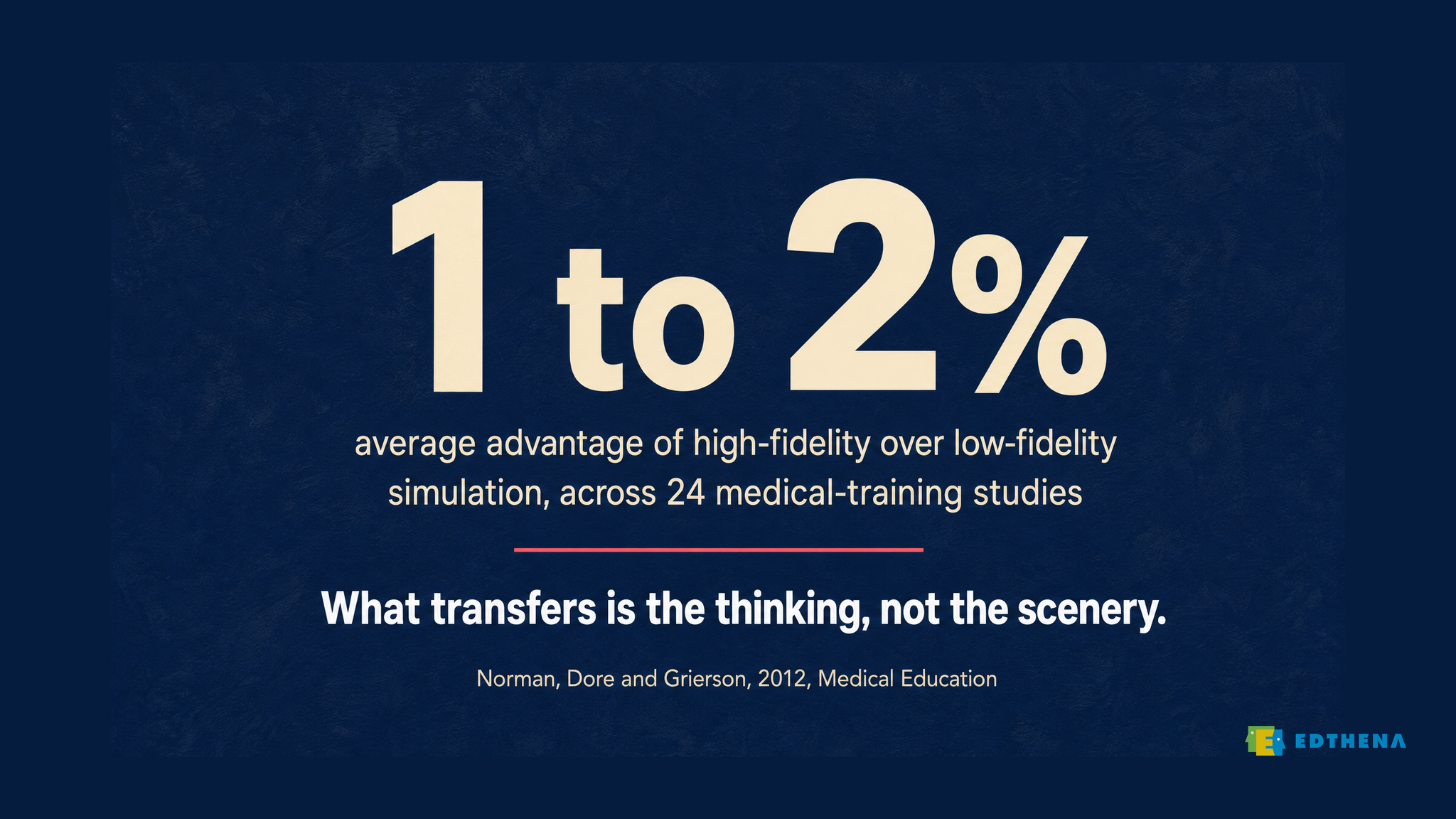
The research on simulation training says realism matters less than people assume. Across 24 studies of medical training, the difference between a high-fidelity and low-fidelity simulation was very small. High-fidelity simulators beat low-fidelity ones by only 1 to 2 percent (Norman, Dore, and Grierson, 2012). What transfers is the thinking, not the scenery. Leading a discussion is a thinking-and-talking task, and the thinking is what a rehearsal practices: parse what the student said, decide the next move, say it.
What we have not found in any published study is whether a voice-only AI rehearsal changes what a working teacher does in her real classroom, and that question is the one this grant exists to answer. Because every teacher in the study rehearses a lesson and then teaches it, scored the same way both times, the study can see directly whether what she practiced showed up with her students.
Who Is Building ART, and What Happens to the Video?
The four co-principal investigators are Scott Acton at the University of Virginia, Nicole Garcia at TeachingWorks at University of Michigan, Meghan Shaughnessy at Boston University, and Adam Geller at Edthena. University of Virginia builds the AI model that reads a transcript of a math discussion and recognizes what the teacher did or didn’t do. This builds upon the type of work that we did in our AI2S Gates-funded project on AI feedback for recorded math lessons. TeachingWorks and Boston University bring more than a decade of research on leading a math discussion well, including the framework that scores both the rehearsal and the real lesson, and they run the field study.
Edthena builds the part the teacher touches: the AI-simulated students, the voice rehearsal, and the coaching conversation. When the project ends, the plan is for the scoring model to be released as open-source code so other researchers can build on the model.
The AI system built during the study to analyze Number Talks will be trained on existing research recordings, lessons collected and hand-coded under earlier studies, not on the lessons teachers record during this field study. Those recordings are collected under each university’s research-ethics approval with the teacher’s consent, de-identified before analysis, and used to measure what changed.
Where Rehearsal Fits in Coaching
A simulation doesn’t take the coach’s place. Coaching works as a cycle: a teacher tries a move, gets specific feedback on the move, and tries again. The hard turn in that cycle has always been the practice, because practice has needed a coach in the room. A rehearsal space handles the practice between visits, so a coach’s time goes to the conversations only a person can have, the same case we made for coaching that trains rather than tracks. The vision for feedback behind this project is that simple: before the lesson, a place to try the move; after the lesson, a look at whether the move showed up; and a coaching conversation about the difference.
If your math curriculum already includes Number Talks, count the rehearsal opportunities your teachers get before a lesson. If the answer is zero, you know why we wanted to build a rehearsal space.
The field study runs in the 2027-28 school year with teachers in grades 2 through 5, and districts whose elementary math curriculum includes Number Talks can take part. Get in touch if you’re interested in participating.
Frequently Asked Questions
What is the ART of Math project?
ART of Math, short for AI Rehearsals for Teachers of Mathematics, is a two-year, $750,000 Gates Foundation research grant combining University of Virginia, Edthena, TeachingWorks at University of Michigan, and Boston University. Edthena builds a Number Talk rehearsal prototype with AI-simulated students; the university partners test whether rehearsing changes what teachers do in real classrooms.
How is a generative AI rehearsal different from avatar-based simulations like Mursion or TeachLivE?
The key difference is the simulation content and use of real lesson material. Avatar simulations run set scenarios in scheduled sessions. The ART of Math rehearsal is built around the teacher’s actual curriculum: the teacher uploads the Number Talk problem they are about to teach, and the AI-simulated students respond to that problem.
Does the AI teaching simulation give the teacher a score?
No. The ART of Math prototype identifies discussion-leading moves so researchers at the University of Virginia, TeachingWorks at University of Michigan, and Boston University can measure change, but the teacher sees a plain-language coaching conversation: the moves she used, one move to try next, and why the move matters.
Is classroom video from the study used to train the AI?
No. The ART of Math scoring model is trained on existing research recordings that were collected and hand-coded under earlier studies. Field-study lessons are collected under university research-ethics approval with teacher consent, de-identified, and used to measure change, and each teacher’s video is uploaded to that teacher’s own private space on the platform.
How can a district take part in the ART of Math field study?
The field study runs in the 2027-28 school year with teachers in grades 2 through 5 whose districts use a math curriculum that includes Number Talks or a similar daily warm-up. Participating teachers rehearse, teach, and review one Number Talk a month with the coaching conversation. Districts interested in taking part can contact Edthena.