PLC Questions 3 and 4 Are Answered in Classrooms, Not Meetings

The four critical questions of a professional learning community split into two kinds of work. Questions 1 and 2 produce team artifacts: a list of essential outcomes, a common assessment, agreed criteria for proficiency. A group can finish those in a room. Questions 3 and 4 produce instructional decisions inside individual classrooms, for named students, on a specific day. Those cannot be finished in a room, and that is where the cycle stalls.
The distinction matters for anyone who schedules PLC time and has to defend it. A team can leave a meeting having genuinely answered the first half of the framework and still change nothing about what happens on Tuesday, because the second half of the framework was never a meeting task.
What are PLC questions 3 and 4?
Solution Tree’s AllThingsPLC states the four critical questions this way:
- What do we want students to learn?
- How will we know if they have learned?
- What will we do if they don’t learn?
- What will we do if they already know what we’re teaching?
Question 3 carries a clause that is easy to skim past: “What systematic process is in place to provide additional time and support for students who are experiencing difficulty?” It is not asking a team to notice which students struggled. It is asking what happens next, and whether that next thing is reliable enough to be called a process.
Choosing what a team works on inside the meeting is its own problem, covered separately in what your PLCs should actually be working on. This post is about the half of the cycle that no meeting can close.
Why do the first two questions close in a meeting and the last two don’t?
Look at what each question produces when a team answers it well.
Question 1 produces a shared target. Teachers study the standards, argue about what mastery looks like in student work, and agree. The output is a document the team holds collectively.
Question 2 produces an instrument. The team designs a common formative assessment, sets the proficiency bar, and calibrates how they will score it. Again, one artifact, owned by the group, finished in the room.
Questions 3 and 4 produce decisions about individual children. Which six students, in which class period, get which different approach, from which teacher, starting when. A team can plan that work, and a good team does. The work itself happens one classroom at a time, in the days after the meeting.

That is a difference in output type, not a difference in effort. The first two questions are group tasks with group deliverables. The last two are individual instructional changes a group can specify but cannot perform. A cycle built entirely around meeting time completes the first half and leaves the second half open.
What did DuFour say a real answer to question 3 requires?
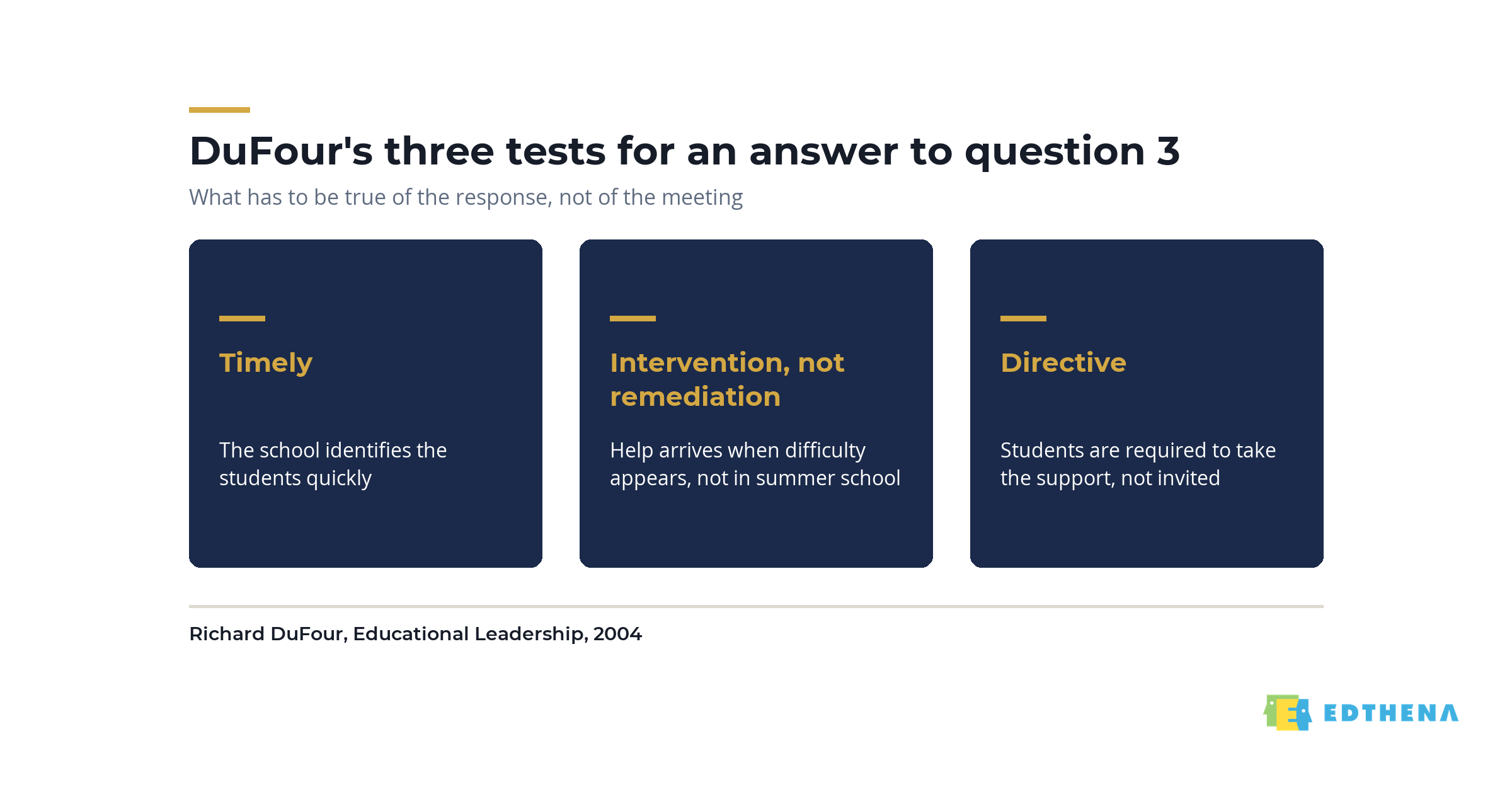
Richard DuFour was specific about this, and the criteria he set are stricter than an agenda item can satisfy. Writing in Educational Leadership in 2004, he argued that a school’s response to students who have not learned must be timely, directive, and based on intervention rather than remediation.
Timely means the school “quickly identifies students who need additional time and support.” Based on intervention rather than remediation means students get help “as soon as they experience difficulty rather than relying on summer school, retention, and remedial courses.” Directive means the plan “requires students to devote extra time and receive additional assistance until they have mastered the necessary concepts” instead of inviting them to seek help.
DuFour called this the dividing line: “The answer to the third question separates learning communities from traditional schools.” He also named what happens when the answer is left unbuilt. “Almost invariably, the school leaves the solution to the discretion of individual teachers, who vary widely in the ways they respond.”
His example of a school that had built the answer was Adlai Stevenson High School in Lincolnshire, Illinois, serving more than 4,000 students. Every student got a progress report every three weeks, and a struggling student triggered a specified sequence: conversations with teacher, counselor, and advisor, a notification home, a pass to the tutoring center, then required tutoring, then a guided study hall of ten or fewer students. The point is not the specific ladder. It is that every rung was decided in advance rather than improvised by whoever noticed.
Why does question 4 get the least attention?
Question 4 asks what happens for students who have already mastered the content, and the people who write about PLCs are candid about how it fares. Douglas Fisher and Nancy Frey, writing on Solution Tree’s blog in 2017, put it plainly: “We know that we have personally spent a lot more time on the first three questions and a lot less time on the last question.” They called it the pesky fourth question, pesky because it does not fit neatly into work already underway.
Their answer starts with a pre-assessment, because those students cannot be identified without checking, and it ends in the same place question 3 does. In their example, sixth-grade history teacher Armando Ramirez gave three writing prompts before a unit on Ancient Egypt. Of 34 students, nine wrote papers showing deep understanding and six more showed substantial prior knowledge. As Ramirez put it: “Nine of my students don’t need this unit at all and I have to plan alternative tasks for them.” Fifteen students needed something different, and planning it carried a name and a date. That is question 4 in its actual form.
What has to be decided before the team leaves the room?
If questions 3 and 4 are executed in classrooms, then the meeting’s job is to make the classroom work specific enough to actually occur. Four things are worth naming before the team disperses.
Which students. Not “the students who struggled with fractions.” The list, by name, per class period, so the teacher who owns the response knows exactly who it is for.
What will be different. DuFour’s “intervention rather than remediation” criterion sets the bar here. Repeating the original lesson to a smaller group does not meet it. The team decides what changes about the explanation, the representation, or the task, and each teacher decides how it lands in their own room.
What comes back. Evidence, not a status update. A work sample, a short reassessment, a clip of the reteach. Something the team can look at rather than take on report.
By when. Timeliness was DuFour’s first criterion, and it is the one that quietly disappears without a date attached.
That list is easy to write and hard to sustain, because between one meeting and the next each teacher is working alone on a specific instructional change, which is exactly the situation an instructional coach exists for. Coaching capacity is the constraint: there are more teachers in that window than there are coaches and principals with hours to give. That gap is what we built AI Coach to carry: our AI-powered instructional coaching platform gives every teacher a private, on-demand coaching conversation where they talk through a lesson, set a goal, and get practical next steps, with differentiation among the teacher practices it covers.
For the broader operating model of running PLCs as a decide, practice, return cycle, see making PLCs actually change teaching, and for why giving and receiving this kind of feedback is its own skill, feedback as professional capacity.
How do you know whether question 3 was actually answered?
There is a test, and it takes one meeting to run. At the start of the next PLC, ask each teacher what changed for the students on the list.
If the answers are about grouping, scheduling, or who got pulled when, the team answered a logistics question and left question 3 open. If the answers describe a different instructional approach and carry evidence of how students responded, the cycle closed. The same test works for question 4: the students who already knew the material either did something else worth doing, or they waited.
Running that check once tells a principal more about PLC health than a term of agenda reviews, and it changes nothing about the schedule, the teams, or the protocol. It changes what the team expects to have in hand when it sits back down.
To make that follow-through available to every teacher rather than the few who get coaching visits, AI Coach runs alongside the coaching a school already provides. Our post on whether AI replaces coaches answers the question leaders ask next, and new teacher induction covers the teachers who need that support most.
Frequently Asked Questions
What are PLC questions 3 and 4?
They are the last two of the four critical questions of a PLC. Solution Tree states them as “What will we do if they don’t learn?” and “What will we do if they already know what we’re teaching?” Question 3 asks for a systematic process of additional time and support. Question 4 covers students who already mastered it.
What do you do when students haven’t learned it?
Richard DuFour set three criteria in Educational Leadership in 2004: the response must be timely, meaning the school identifies those students quickly; based on intervention rather than remediation, meaning help arrives as soon as difficulty appears instead of through summer school or retention; and directive, meaning students are required to take the additional support rather than invited to seek it.
What do you do when students already know what you are teaching?
Start with a pre-assessment, because those students cannot be identified without checking. Douglas Fisher and Nancy Frey describe three responses used by sixth-grade teacher Armando Ramirez after a pre-unit writing task identified 15 of his 34 students: spiral review tasks revisiting earlier content, extension tasks going deeper into the current unit, and optional peer tutoring.
Who answers PLC questions 3 and 4, the team or the teacher?
Both, in sequence. The team decides which students need a response and what will be different about the instruction they get. The individual teacher executes that decision in their own classroom in the days that follow. Questions 1 and 2 end with a team artifact; questions 3 and 4 end with a teaching move in one room.
How do you know whether question 3 was actually answered?
Ask each teacher at the next meeting what changed for the students on the list. Answers about grouping, scheduling, or pull-out timing mean a logistics question was answered. Answers that describe a different instructional approach, with evidence of how students responded, mean the cycle closed.