Why Most Teacher Observation Feedback Doesn’t Change Teaching

A RAND survey of nearly 2,000 teachers found that 76 percent said their evaluation system led to instructional improvements. But the same survey found that teachers rated feedback from school leaders as less helpful than feedback from peers (74 percent versus 86 percent). The gap is not about what principals know. It is about what happens between the classroom observation and the moment feedback reaches the teacher.
Teacher observation feedback fails most often not because principals give bad advice, but because the advice arrives too late, covers too much, and feels disconnected from what actually happened in the classroom. The research is clear that frequent, specific, timely feedback changes teaching. The problem is that the current feedback pipeline makes all three nearly impossible.
What the Research Says About Observation Feedback
The evidence base for observation-linked feedback is strong. Kraft, Blazar, and Hogan’s 2018 meta-analysis in the Review of Educational Research examined 60 causal studies and found pooled effect sizes of 0.49 standard deviations on instructional quality and 0.18 standard deviations on student achievement. Those are meaningful numbers. Coaching that includes observation and feedback consistently improves both how teachers teach and how students learn.
The Gates Foundation’s Measures of Effective Teaching (MET) project, which studied nearly 3,000 teachers across seven U.S. districts, confirmed that classroom observations can reliably identify effective teaching when combined with student surveys and achievement data. The project tested five major observation instruments and recommended using multiple observers to increase reliability.
RAND’s American Teacher Panel survey added an important detail: frequency matters.
Among teachers observed four or more times per year, 83 percent found the evaluation system helpful. Among those observed less frequently, the number dropped to 65 to 76 percent. More observations, paired with feedback, produce better outcomes.
The research points in one direction: observe more, give feedback faster, and make it specific to what happened in the classroom. The question is why most schools can’t do this.
Where the Feedback Pipeline Breaks Down
The National Council on Teacher Quality (NCTQ) found that tenured teachers receive an average of 2.4 formal observations per evaluation cycle. Non-tenured teachers receive 3.3. In 72 percent of districts, each observation requires written feedback accompanied by a conference. That means a principal with 30 teachers is writing 70 to 100 observation reports per year.
Each report takes one to three hours. The principal observes a classroom during a brief walkthrough or formal observation, takes notes on what students and the teacher are doing, leaves, and then sits down to translate those notes into a structured document. That document needs to reference the school’s instructional framework, identify which domains or indicators the evidence supports, and suggest specific next steps for the teacher. Adam Oakley, principal of Spokane Garry Middle School in Spokane Public Schools, described his experience before changing his process: “A typical observation takes me two to three hours to complete the write-up.”
The math is punishing. At two hours per write-up and 80 observations per year, that is 160 hours, or four full work weeks, spent writing feedback. This is before accounting for the pre-observation meetings, the post-observation conferences, the hallway conversations, and everything else a principal does in a day.
The result is predictable. Feedback gets delayed. TNTP found that observation rubrics “give observers too much to look for in a short amount of time, creating inflated and inaccurate ratings.” When principals are rushing to clear a documentation backlog, quality suffers. A report written two weeks after the observation becomes a postmortem: it arrives so long after the lesson that neither the principal nor the teacher can reconstruct what happened with any specificity.

Late Feedback Is Not Feedback
Thomas R. Hoerr, emeritus head of school at New City School in St. Louis, wrote in ASCD that observations should be “part of a transformational exchange that develops trust and leads to growth,” not “mere transactions” where principals “share judgments and hand out recommendations.” He is right about the goal. But transformational feedback requires timeliness, and timeliness requires that the write-up not consume the principal’s entire afternoon.
Edutopia recommends that principals provide teacher observation feedback within 48 to 72 hours of an observation. This is good advice that most principals cannot follow, because the write-up alone can take longer than the gap between the observation and the next crisis that pulls them away from their desk.
When feedback arrives late, several things happen. The teacher has moved on to different lessons and different challenges. The specific classroom moments that the principal observed have faded from both parties’ memories. The conversation becomes abstract rather than grounded in shared experience. And the teacher, having waited days or weeks with no response, has already drawn their own conclusions about what the principal thought of the lesson.
Waiting days or even hours after an observation reduces feedback impact and increases teachers’ anxiety, leaving room for negative assumptions. The silence itself becomes a message, and rarely a positive one.
What Good Feedback Actually Looks Like
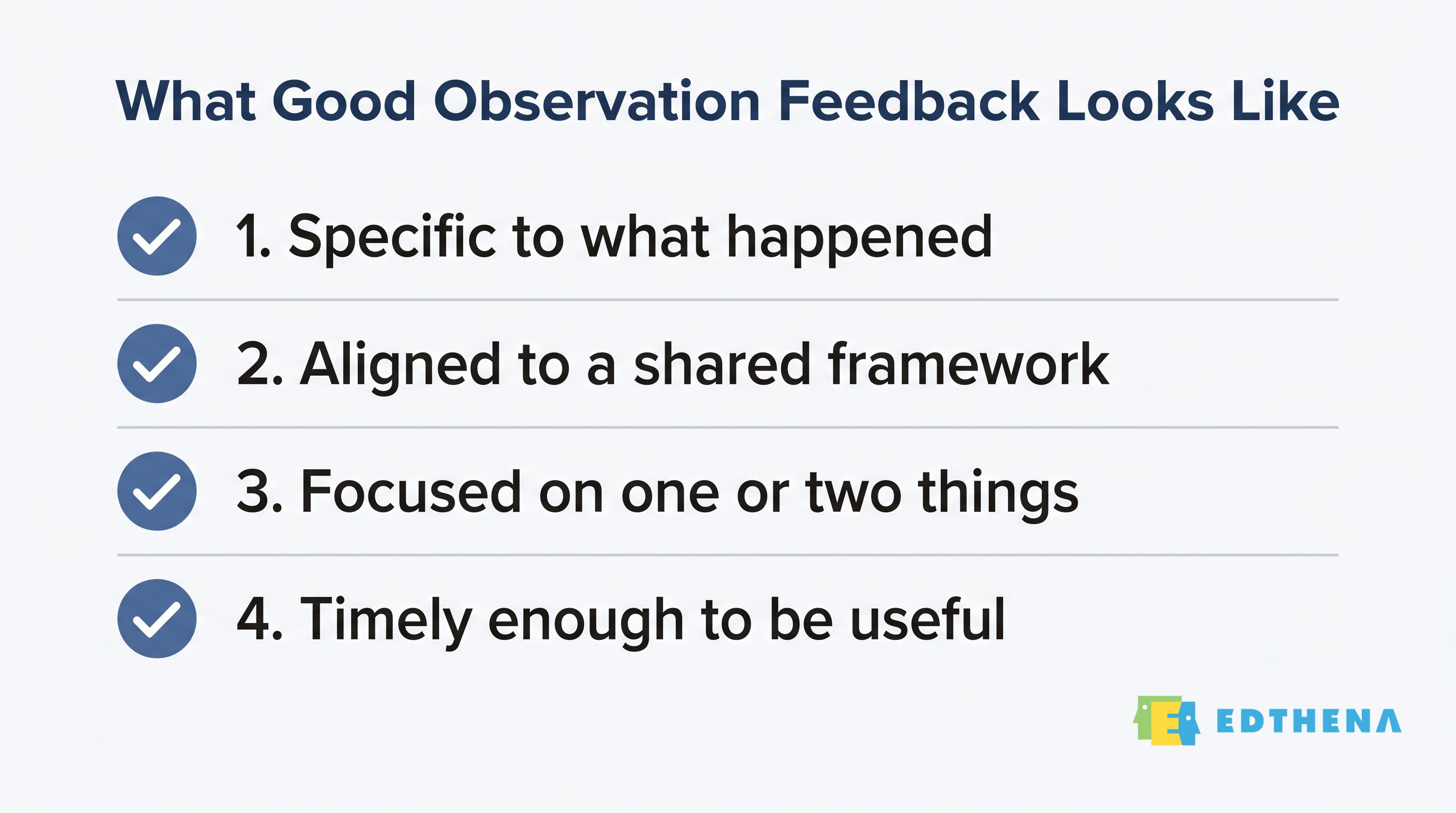
The research and practitioner literature converge on a few principles. Good teacher observation feedback is:
- Specific to what happened. Not “good questioning techniques” but “when you asked students to explain their reasoning after the think-pair-share, three groups were able to articulate the difference between area and perimeter.” Evidence from the actual classroom, not generic praise.
- Aligned to a shared framework. Both the principal and the teacher should be able to connect the feedback to a common understanding of effective instruction. Whether that is the Danielson Framework for Teaching, Marzano, or a district-specific rubric, the framework provides shared language. The MET project found that framework-aligned observations produce more reliable and useful data.
- Focused on one or two things. Edutopia advises identifying one “leverage point” per observation, an idea for how more learning might take place. Hoerr recommends a 5-to-1 ratio of positive to constructive comments. The point is not to catalog every strength and weakness but to give the teacher something actionable to try next.
- Timely enough to be useful. RAND data shows that teachers observed more frequently find the system more helpful. Frequency only works if feedback follows quickly. A principal who observes 15 teachers per week but provides feedback two weeks later is not giving frequent feedback. They are creating a documentation backlog.
None of these principles are controversial. Every principal knows this is what good feedback looks like. The constraint is not knowledge. It is time.
Fixing the Feedback Pipeline
If the bottleneck is the time between observation notes and finished, framework-aligned feedback, then the solution is to compress that step. Not to skip the framework alignment. Not to replace written feedback with a quick hallway conversation. Not to use a checkbox form that teachers experience as impersonal. The solution is to make the translation from notes to structured feedback fast enough that principals can actually deliver it the same day.
This is the problem Observation Copilot was built to solve. A principal enters observation notes and selects the instructional framework. The tool generates a structured first draft of feedback, with evidence aligned to framework components and suggested next steps, in seconds. The principal reviews, refines, and delivers.
Oakley’s experience is representative: his post-observation time dropped from two to three hours to 20 to 30 minutes per teacher.
The tool supports the Danielson Framework for Teaching and other popular instructional frameworks, with the option to upload a custom framework. Lee Kappes, Ed.D., CEO of The Danielson Group, noted that the integration helps “principals spend less time on paperwork and more time engaging in thoughtful, evidence-based conversations with teachers.”
When the write-up takes minutes instead of hours, everything downstream improves. Feedback arrives while the lesson is fresh. The post-observation conversation is grounded in shared, specific memory. The principal has time for the next observation instead of being buried in the last one. And the cycle that RAND and Kraft’s research describe, where more frequent observation leads to better teaching, becomes sustainable instead of aspirational.

What to Do Next
If your observation feedback process feels like it is not changing teaching, start by measuring the turnaround time. How many days pass between the observation and the moment the teacher has feedback in hand? If the answer is more than 48 hours, the issue is likely the pipeline, not the principal’s coaching skill.
Three steps to consider:
- Audit your current turnaround. Track how long each observation-to-feedback cycle actually takes across 10 observations. The number is usually higher than principals estimate.
- Simplify what you’re trying to say. One specific observation, connected to one framework component, with one suggested next step. A focused 200-word response delivered the same day is more useful than a comprehensive 1,500-word report delivered two weeks later.
- Address the write-up step directly. Whether you use a tool like Observation Copilot or build your own shortcut, the goal is the same: reduce the time between leaving the classroom and delivering written feedback to under 30 minutes.
Principals can use Observation Copilot for free at ObservationCopilot.com.
Frequently Asked Questions
How soon after an observation should a principal give feedback?
Research and practitioner guidance recommend within 48 hours. Edutopia suggests 48 to 72 hours as the outside limit. Feedback delivered the same day or next day is most effective because both the principal and teacher can recall specific classroom moments.
How many observations per year do teachers actually receive?
According to NCTQ data, tenured teachers receive an average of 2.4 observations per evaluation cycle, and non-tenured teachers receive 3.3. RAND research found that teachers observed four or more times per year were significantly more likely to find the feedback system helpful.
Does observation feedback actually improve teaching?
Yes. Kraft, Blazar, and Hogan’s 2018 meta-analysis of 60 causal studies found that coaching programs that include observation and feedback improve instructional quality by 0.49 standard deviations and student achievement by 0.18 standard deviations. The effect depends on feedback being timely, specific, and sustained.
Why do teachers find peer feedback more helpful than principal feedback?
RAND survey data shows teachers rated peer feedback as helpful 86 percent of the time, compared to 74 percent for feedback from school leaders. This may reflect that peer observers are more likely to give immediate, specific, collegial feedback, while principal feedback is often delayed by documentation requirements and colored by the evaluative relationship.