Why teachers need a trainer, not a fitness tracker, for professional growth

The promise of technology in classrooms has always been alluring. Imagine an app or tool that could instantly tell teachers how they’re teaching, where their strengths are, and what they should fix.
In theory, it sounds great. It’s kind of like strapping on a fitness tracker, collect the data, study the readout, and surely improvement will follow.
In practice, it’s more complicated than that. After all, if fitness trackers were all we needed to achieve greatness, we’d all be Olympic athletes by now.
The reality is that raw data, no matter how detailed or compelling, doesn’t build skill on its own. To improve, teachers need more than a readout. They need a coach.
That’s why Edthena’s AI Coach is built less like a fitness tracker and more like a personal trainer. It helps educators build instructional muscle, develop professional stamina, and sustain meaningful growth over time.
Why data alone doesn’t improve teaching
It’s easy to understand the appeal of data-first coaching tools. Seeing a graph or transcript of classroom talk can feel like the key to unlocking growth.
Closing the rings on your Apple Watch gives you a sense of accomplishment, and it even features a fun celebration animation.
After all, athletes use data to track performance, so why shouldn’t teachers?
Relying on data alone comes with limitations, especially when it comes to the types of complex changes that teachers must make within learning environments and then sustain over time. Numbers can be informative, but they don’t automatically lead to change.
Consider how this plays out in fitness:
- A readout of your daily steps doesn’t make you more ready to run a marathon.
- A chart showing minutes “in the zone” doesn’t improve your running technique.
- A weekly recap doesn’t teach you how to lift with proper form or avoid injury.
Research confirms the limits of data dashboards for teachers
Research on fitness apps shows that when tools focus heavily on numeric targets, they can reduce motivation because the experience starts to feel like compliance instead of growth. This study found that users were more motivated when guidance and reflection were built into the experience.
The researchers’ conclusion? Tools focused purely on data tracking need to prioritize intrinsic motivation and psychological support over raw metrics. In other words, they need to be more like trainers and less like trackers.
Similarly, research on self-tracking tools found that people do not just want data. They want help interpreting it. Users in one study said they were more motivated when the tool offered coaching-style support.

The same is true for classroom analytics tools that summarize talk time or generate engagement reports. While they may help surface patterns, they stop short of guiding teachers through the kind of thinking and analysis that leads to sustained instructional change. After all, a digital dashboard of teaching practice is simply this decade’s version of the data wall, which highlights patterns but does not guide changes in practice.
A recent multi-site study looked at what happens when teachers receive automated feedback without structured reflection. The researchers found improvements in narrow behaviors but not in broader instructional practice. This reinforces that data visibility can prompt quick adjustments, but deeper changes require guided reflection and continued guidance.
Without guidance, context, and structured reflection, data alone leads to short-term tweaks, not long-term transformation. Teachers do not need more readouts. They want thoughtful support to build habits that last. There is growing evidence that pairing data with guided reflection leads to deeper changes in instruction, especially when that reflection is supported by AI-powered coaching feedback. One study found that teachers were more likely to internalize new strategies when the reflection process included structured support.
This isn’t a new idea
This pattern has been well documented. A widely cited meta-analysis of professional learning showed that teachers are far more likely to use new strategies in the classroom when they receive ongoing coaching, compared to when they only receive workshops or demonstrations. This conclusion has been consistently replicated across settings.
Their work emphasized that teachers do not just need to learn a new strategy. They need support while trying it, reflecting on it, and adjusting it with their own students. Professional development that stops at explanation or demonstration rarely changes classroom instruction. Transfer happens when teachers have opportunities to try strategies, receive feedback, and reflect on what happened.
The findings are often summarized visually like this:

Why teachers need a trainer
This is where the trainer vs. tracker metaphor really matters. A fitness tracker tells you what you did. A trainer helps you decide what to do next.
This aligns directly with decades of instructional coaching research showing that reflection plus guided practice leads to sustained changes in teacher practice.

A trainer helps you:
- Model technique. Showing you not just what to do, but how to do it correctly.
- Offer timely feedback. Providing corrections and encouragement in the moment.
- Create a tailored plan. Adapting workouts to your strengths, weaknesses, and goals.
- Maintain progress. Helping you sustain improvement over the long term, not just for a week.
This balance of structure and autonomy is what makes growth sustainable. Instruction is a skill, and like any skill, it needs intentional training. Without guided practice and feedback, it’s easy to develop “bad form” in instruction or to burn out from trying to do too much, too fast.
What about human instructional coaches?
Some might say that the role of the trainer is already filled. Schools employ instructional coaches who observe lessons, offer feedback, and guide teacher development. Human coaches and instructional lead teachers are essential, and nothing replaces their expertise.
But even the best coach can only be in one room at a time. Their time is finite. Their reach is limited.
This is where AI Coach steps in, not to replace human coaches, but to scale their impact. It gives every teacher the opportunity to engage in self-reflection and growth, even when a coach or administrator can’t be present. Think of it as putting a personal trainer in every classroom, every day, while preserving the value of live coaching relationships.
And it’s designed with real schools in mind. There’s no tech lift required for administrators, and teachers can get started immediately.
Building muscle: Strengthening core instructional practice
A trainer doesn’t ask you to lift the heaviest weights on day one. They focus on targeted exercises that gradually strengthen your muscles.
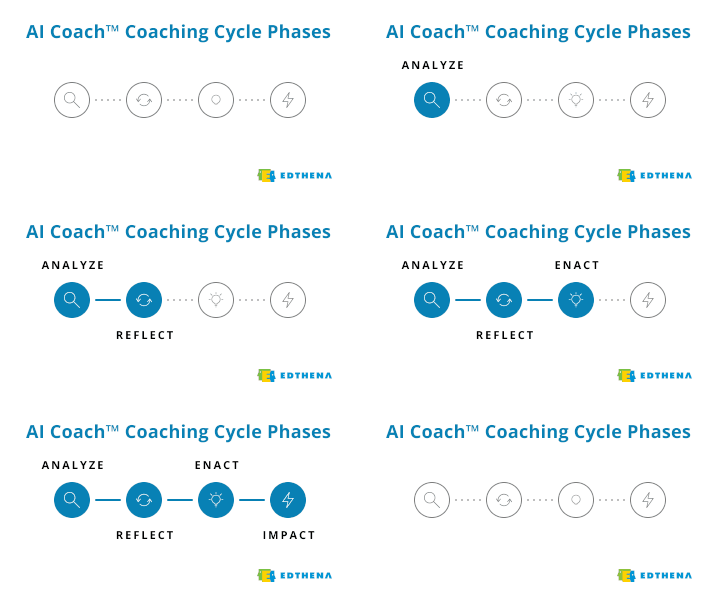
AI Coach works the same way, structuring professional learning into a manageable cycle:
- Video analysis and reflection. A classroom video is uploaded and reviewed with guidance from the virtual coach to reflect on a specific instructional focus.
- Action plan development. Using curated resources and strategies, teachers work with the virtual coach to create a customized action plan.
- Classroom implementation. The newly developed plan is put into practice during real classroom instruction.
- Impact assessment and repetition. The impact of these changes is assessed, and the cycle is repeated to reinforce ongoing improvement.
Each cycle is like a set of reps, focused, repeatable, and designed to build lasting instructional muscle. Admittedly, the coaching cycle isn’t quite as easy as having AI analyze a lesson and suggesting what to work on. But as with fitness training, lasting results come from sustained effort and hard work.
Importantly, just like a skilled trainer, AI Coach doesn’t dictate a rigid plan. It acts as a thought partner, helping teachers stay in control of their strategy. And because videos remain private to the teacher, this reflection process becomes a safe, judgment-free space. They can even earn PD clock hours for their work.
At the same time, administrators retain visibility into focus areas and participation trends, allowing them to support growth without micromanaging.
Developing consistent teaching practice over time
Strong muscles are only part of the equation. Without consistency, progress fades. Trainers build endurance through regular practice over weeks and months.
AI Coach mirrors this approach by supporting teachers across the school year. Instead of “one-and-done” feedback, teachers build the habit of continuous improvement. Over time, this consistency leads to more confident practice and stronger student outcomes.

When teachers combine the accountability of a trainer with the insights of their own reflection, they don’t just get better temporarily. They sustain growth.
AI Coach gives teachers the structure and support to:
- Strengthen core skills through repeated cycles of practice.
- Build stamina to sustain improvement throughout the year.
- Retain agency and adaptability in their growth process.
- Extend the reach of human coaches by being available anytime, anywhere.
The result is a healthier, stronger teaching practice that goes beyond short-term fixes and fosters lasting professional resilience.
Ready to strengthen your teachers’ practice?
Just as no one becomes fit from a tracker alone, teachers don’t transform from data alone. They need the structure, support, and personalized guidance that only a trainer can provide.
Unlike tools that simply record classroom talk or produce static reports, Edthena’s AI Coach delivers personalized, reflective, and sustained support. It helps educators take action, build skills that last, and create a sustainable path toward instructional excellence.
Contact us today to learn how AI Coach can support every teacher in your school with personalized, expert-level coaching.
References:
Carter, D., Robinson, K., Forbes, J., & Hayes, S. (2018). Experiences of mobile health in promoting physical activity: A qualitative systematic review and meta-ethnography. PLoS ONE, 13. https://doi.org/10.1371/journal.pone.0208759.
Demszky, D., Liu, J., Hill, H., Sanghi, S., & Chung, A. (2024). Automated feedback improves teachers’ questioning quality in brick-and-mortar classrooms: Opportunities for further enhancement. Comput. Educ., 227, 105183. https://doi.org/10.1016/j.compedu.2024.105183.
Joyce, B., & Showers, B. (1982). The coaching of teaching. Educational Leadership, 40(1), 4–10. https://eric.ed.gov/?id=EJ269889