You’re Measuring Student Talk Time Wrong. Do This Instead

Measuring classroom engagement doesn’t seem complex: anyone can use tally marks to count, and then try to increase the minutes of student talk time or number of hands raised.
But having students talk more doesn’t cut it for accurately gauging if they are engaged in productive learning. And without solid insights about student engagement, teachers can’t efficiently improve their instructional practices.
If you’re a school leader or coach supporting teachers to improve classroom engagement, you’ll need to look beyond raised hands.
We’ve outlined how educators can analyze student talk time and teacher talk time to better understand student learning.
Plus, read on for what the 70/30 rule really means, six strategies to increase student talk time, and how teachers can take a structured approach to implementing next steps that improve classroom engagement.
What is student talk time analysis?
Student talk time analysis measures how much of a K-12 lesson students spend talking compared with the teacher, then looks at the quality of that talk. In a video coaching platform it happens automatically: the tool charts the student-to-teacher talk balance for each lesson and shows where student talk reflects reasoning, collaboration, or misconceptions instead of one-word answers. That turns a raw talk-time ratio into coaching evidence a teacher can act on.
How to Analyze Teacher Talk Time for Student Engagement
One way to consider student engagement starts with looking at teacher talk time. This goes beyond just minimizing teacher talk in order to increase student talk, though.
There is real room to improve here. According to classroom research synthesized by John Hattie and reported by Education Week, teachers talk for 70 to 80 percent of class time on average, and less than 5 percent of class time involves meaningful discussion of ideas.
It’s important for teacher talk to be clear, concise, and focused on driving students’ productive learning.
One of the best ways to gain insights from teacher talk is, in the words of Jim Knight, to access a clear picture of their current reality with classroom video.
Teachers first record videos of their classroom instruction in order to gain accurate classroom evidence of their teacher talk.
As they review their classroom video, teachers can easily count the number of times they spoke and for how long.
But for more meaningful analysis, teachers need to also analyze their talk time for specific instructional strengths and areas for growth aligned with increasing student engagement.
When analyzing teacher talk time for insights about student learning, look for these skills:
- Clarity in presenting academic content
- Questioning techniques that elicit student thinking
- Facilitating productive student discussion and dialogue
This reflection on teacher talk time can yield a lot of information and ideas about how to improve instruction to be more engaging, but trying multiple ideas at once will not be effective.
Picking one thing to work on at a time helps teachers make instructional changes in a measurable and iterative way and is based on the research of improvement science.
Once teachers pick one thing to change within their classrooms, they should pre-plan how they will collect new data to measure the impact on student engagement. Then teachers will be able to assess if the change worked and if they should continue this practice within their teaching.
This disciplined approach gives teachers the ability to improve their teacher talk time in measurable ways before immediately moving on to other instructional skills.
What Is a Good Teacher Talk Time to Student Talk Time Ratio?
Educators often ask about the right ratio between teacher talk time (TTT) and student talk time (STT).
The most common guideline is the 70/30 rule: students should do about 70 percent of the talking, and teachers about 30 percent. The guideline comes from language teaching, where maximizing student speaking practice is the goal, and it has spread into general classroom practice as a rough benchmark.
Compare that target to the research above, and the gap is clear. If teachers talk 70 to 80 percent of class time on average, most classrooms have the ratio roughly inverted.
But here’s the catch: a ratio is a starting point, not a goal.
A classroom can hit 70 percent student talk while students chat off-topic in pairs. Another classroom can sit at 50/50 while students build on each other’s reasoning in a rich discussion. The percentage tells you where to look. It doesn’t tell you what the talk is accomplishing.
That’s why the analysis questions in this article focus on the quality of teacher and student talk, not just the minutes.
How to Analyze Student Talk Time for Student Engagement
It may seem obvious that understanding student engagement involves looking at student talk time.
However, students don’t need to just talk more, and every minute of talking doesn’t necessarily indicate the same depth of learning.
Similar to analyzing teacher talk time, reviewing student talk time is more effective when done looking at classroom video after a lesson instead of trying to gain deeper insights in the moment.
While watching and reflecting on a teaching video, you can begin by tallying hands raised or the number of students participating. But again, you’ll want to go beyond these surface observations.
Analyze student talk time by asking these questions:
- What do student responses show about mastery or misconceptions about academic content?
- How does student talk engage other students as learners, not just the teacher?
- How are students taking risks and engaging in productive struggle?
With this deeper understanding of what student talk time demonstrates about classroom learning, teachers are ready to try student-facing classroom strategies that can improve engagement.
Just like with addressing teacher talk time, it’s too complex to address various elements of student talk simultaneously.
Improvement science research supports picking one strategy or change to make at a time. Teachers should identify a single classroom technique to try and then measure its impact on student talk time to determine if they will continue using it.
This structured approach helps educators more effectively implement concrete and focused next steps to improve classroom engagement.
Free download: Use our one-page Student Talk Time Analysis Template (PDF) during your next video review. It walks through measuring talk time, the analysis questions from this article, and picking one change to try.
6 Strategies to Increase Student Talk Time
Once a teacher has analyzed their classroom talk and picked a focus, these strategies give students more opportunities to do the thinking and talking. Remember the improvement science approach: choose one, try it, and measure its impact on video before adding another.
- Use structured pair routines. Think-pair-share and turn-and-talk give every student a speaking turn, not just the students who raise their hands. Adding roles, such as speaker and summarizer, keeps both partners accountable.
- Extend wait time. Give students several seconds of think time after a question before calling on anyone. The silence feels long to the teacher, but it produces longer and more thoughtful student responses.
- Ask students to respond to each other. Prompts like “Do you agree or disagree with what she said?” and “Can you add on to that idea?” redirect talk from teacher-to-student ping-pong into student-to-student discussion.
- Provide sentence stems. Frames like “I noticed that…” and “I disagree because…” lower the risk of speaking up, especially for multilingual learners and quieter students.
- Shift from recall questions to reasoning questions. Questions with one right answer produce one short answer. Questions like “How do you know?” and “What would happen if…?” produce extended student talk worth analyzing.
- Hand over discussion structures to students. Small-group protocols with rotating facilitators, or formats like Socratic seminars, make student talk the center of the lesson rather than an interruption to it.
After trying one of these strategies, the measurement loop matters: record another lesson, compare the talk time data, and look at what the student talk now shows about learning.

Use Tech to Measure and Analyze Talk Time Automatically
When teachers are measuring classroom engagement, they need to first cast a wide view to collect and analyze various pieces of teacher and student talk time data.
The counting part of that work no longer needs to happen by hand. VC3, Edthena’s video coaching platform, analyzes uploaded lesson videos and presents an easy-to-read chart showing the ratio of student-to-teacher talk time. Teachers and coaches start from an accurate measurement and spend their energy on the analysis questions above instead of on tally marks.
But when it comes to instructional improvement, teachers often need support to go from big-picture thinking and reflection to bite-sized classroom implementation.
This is often why coaching is so important for teachers: to provide guidance in the complex thinking work required for understanding and implementing different teaching practices.
AI Coach by Edthena is a platform that supports teachers with a computerized coach who guides them in “looking big” and then picking one skill or strategy to work on, with a way to measure impact on student engagement.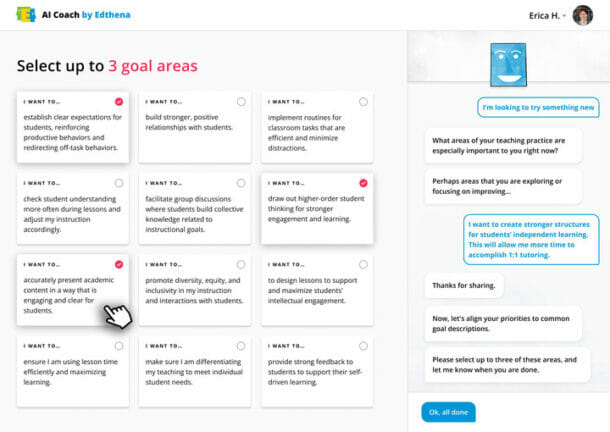
First, teachers are asked to focus a video reflection on specific instructional skills, such as facilitating group discussions or eliciting student thinking through questioning.
As they analyze teacher and student talk time in their classroom videos, teachers access personalized reflection questions to prompt deeper insights about their instruction and student engagement.
A key step in this independent teaching analysis comes next when teachers receive support and guidance for developing their plan for implementing a bite-sized action step and then monitoring progress.
The AI Coach platform provides a guided process for teachers to:
- identify dates for next steps and classroom data to gather
- assess the impact of any change on student engagement and learning, and
- determine if they will continue the change or try another strategy
This provides teachers the structure to work on a single skill or strategy and determine if it impacts student engagement in their classroom before trying another idea. This is aligned to the best practices of improvement science.
AI Coach also gives educators a secure and private place to record and synthesize findings about student talk time and learning.
FAQ: Student Talk Time and Teacher Talk Time
What is student talk time (STT)?
Student talk time (STT) is the portion of a lesson when students are the ones talking: answering questions, discussing with peers, explaining their reasoning, or presenting ideas. STT is commonly measured as a percentage of total class time, but the depth of learning the talk shows matters more than the minutes.
What is teacher talk time (TTT)?
Teacher talk time (TTT) is the portion of a lesson when the teacher is talking: presenting content, giving directions, asking questions, and giving feedback. Research synthesized by John Hattie found teachers talk for 70 to 80 percent of class time on average. Effective analysis of TTT looks at clarity, questioning techniques, and how teacher talk facilitates student discussion.
What is the 70/30 rule in teaching?
The 70/30 rule is a guideline suggesting students should do about 70 percent of the talking in a lesson while the teacher talks about 30 percent. It originated in language teaching, where student speaking practice is the priority. It’s a useful benchmark for noticing imbalance, but the quality of the talk matters more than hitting the exact ratio.
What is a good ratio of teacher talk to student talk?
There is no single correct ratio. A useful approach is to measure the current ratio, compare it to what the lesson was designed to accomplish, and look at what the student talk shows about learning. A discussion-based lesson should show far more student talk than a lesson introducing brand-new content.
How do you measure student talk time?
The most reliable way is to record a lesson on video and review it afterward, since in-the-moment tallying misses too much. Teachers can time talk segments manually, or use a platform like VC3 that charts the student-to-teacher talk time ratio automatically. From there, analyze what the student talk shows about mastery, peer-to-peer engagement, and productive struggle.
What is student talk time analysis?
Student talk time analysis measures how much of a lesson students spend talking compared with the teacher, then looks at the quality of that talk. In a video coaching platform like VC3 it happens automatically: the tool charts the student-to-teacher talk balance for each lesson and shows where student talk reflects reasoning, collaboration, or misconceptions instead of one-word answers, turning a raw talk-time ratio into coaching evidence a teacher can act on.
Deeper Analysis of Talk Time Can Reveal More About Classroom Engagement
Student engagement is a major component of active student learning. To better understand how students are engaging in the classroom, it’s important to look and listen more closely to teacher talk and student talk time.
This analysis generates plenty of insights and ideas to try in the classroom.
Educators and school leaders should remember that trying and measuring one strategy at a time is more effective for continuous improvement.
A version of this article appears on The Learning Counsel website. Click here to read it.