What to Fund in Fall Professional Development: Building Professional Learning That Actually Sticks

Fall professional development budgets are set months before school starts, and the calendar tends to fill in the same way it always has: a two-day workshop before students arrive, a vendor presentation in October, a half-day in January. The dollars go out, the sessions happen, and by February, classroom practice looks largely the same as it did in August.
The research on why this happens has been available for decades. In the three districts TNTP studied for its 2015 report “The Mirage,” only about three in 10 teachers improved substantially over a two-to-three-year period, despite spending that averaged roughly $18,000 per teacher per year on professional development. This is not a failure of effort or intention. It reflects a structural reality. Most of those dollars flow to activities that feel productive but are not designed to produce lasting change.
This guide is a prioritization framework for leaders planning fall budgets. It covers what the research says about professional learning that actually transfers to classroom practice, a “fund this, not that” decision frame for common budget choices, and how to extend coaching capacity without adding staff.
Why One-Off Workshops Don’t Change Classroom Practice
A 2018 meta-analysis of teacher coaching by Kraft, Blazar, and Hogan, published in Review of Educational Research, found that coaching produced positive effects on instructional practice (0.49 standard deviations) and student achievement (0.18 standard deviations) across 60 causal studies. The workshop model, by contrast, produces no comparable effect size in the literature.
Workshops fall short not because the content is bad, but because they lack the follow-through structure. Learning Forward’s Standards for Professional Learning define effective professional development as learning that is sustained over time, embedded in daily work, and supported by coaching and collaboration. A two-day training checks none of those boxes.
The mechanism is straightforward. Teachers leave a workshop with new knowledge but return to classrooms where the habits, structures, and feedback loops that support experimentation do not yet exist. Without observation, feedback, and help adjusting, new approaches get dropped under the pressure of a normal school day. Knowledge does not become practice on its own.
The unit of impact is not the training event. It is the coaching cycle that follows.
What the Research Says Makes Professional Learning Stick
Research on teacher professional development has converged on a consistent set of characteristics. Learning Forward’s Standards for Professional Learning and the Kraft, Blazar, and Hogan meta-analysis identify the same core elements:
- Duration and frequency. More sessions over more time, with practice in between, produce more change than concentrated bursts. A single semester-long coaching engagement outperforms three separate two-day workshops.
- Job-embedded application. Learning that happens in or near the classroom, connected to real instructional challenges, transfers more reliably than learning in conference rooms or off-site venues.
- Coaching and feedback. Teachers need someone observing their practice, asking reflective questions, and helping them identify what to try next. This is the hardest element to scale, but it has the largest effect size.
- Teacher-driven goals. Professional learning is more durable when teachers identify their own focus area rather than having one assigned. Goal ownership predicts implementation.
- Collaborative inquiry. Regular opportunities for teachers to share what they are trying, examine evidence together, and refine their approaches accelerate growth in ways that isolated practice cannot.
The common thread across all five is time and structure. Professional learning that changes classroom practice is built into how a school operates, not scheduled as an annual event.
A “Fund This, Not That” Decision Frame for Teacher Professional Development
Not all professional development spending is equal. Here is a practical framework for evaluating fall allocations.

Fund: Sustained Coaching Infrastructure
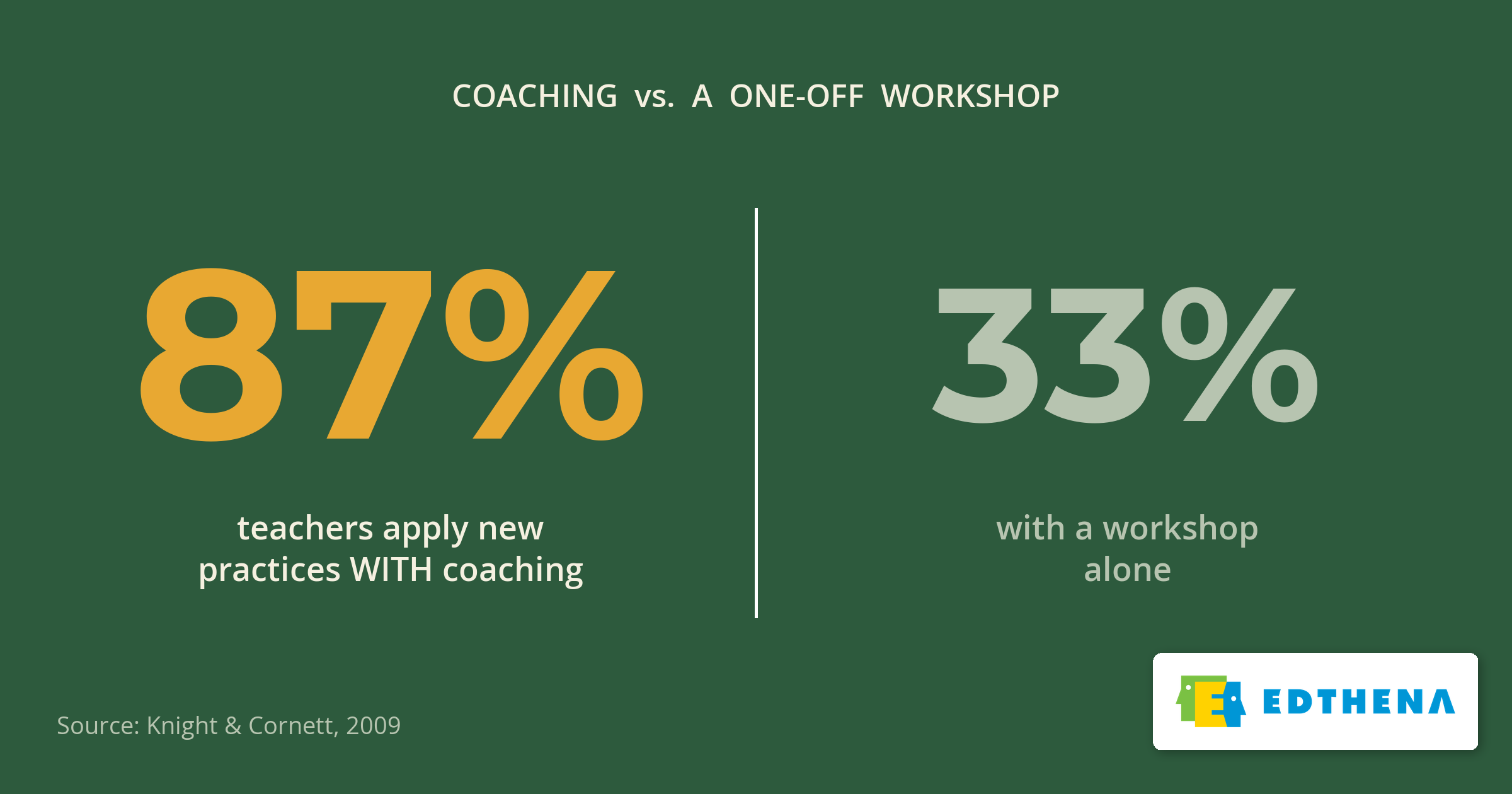
Instructional coaching is the highest-leverage investment available to most schools. Knight and Cornett (2009) found that teachers who received coaching implemented new practices at a rate of 87 percent, compared to 33 percent for teachers who attended a workshop without coaching. That gap reflects what follow-up structure actually does.
What this looks like in practice:
- Dedicated coaching time protected in teacher and coach schedules
- Observation cycles with structured pre- and post-conversation protocols
- A defined number of coaching conversations per teacher per semester (more conversations produce more change; even two structured conversations per quarter show measurable results)
Fund: Job-Embedded Professional Learning Communities
Professional learning communities (PLCs) produce results when they are structured around instructional practice and student evidence, not administrative updates. Learning Forward’s Standards for Professional Learning call for regular collaborative inquiry where teachers examine student work, identify patterns, set goals, and share what they are trying in classrooms.
Funded well, this means:
- Protected time in the master schedule (not relying on voluntary after-school sessions)
- Facilitation training for lead teachers or instructional coaches
- Clear protocols that keep discussions focused on instruction and evidence
Fund: Video-Based Observation and Reflection
Video tools let teachers observe their own instruction, notice patterns they cannot see in the moment, and set specific improvement goals. Teachers who watch recordings of their own teaching routinely surface things they miss while teaching, from how questions are distributed across the room to how long they actually wait for student responses.
Research supports the mechanism. Sherin and van Es (2009, Journal of Teacher Education) found that structured video review develops teachers’ professional vision, their capacity to notice and interpret what matters in classroom interactions, and leads to improvements in instructional practice. A review by Gaudin and Chaliès (2015, Educational Research Review) examined nearly 200 studies of video use in teacher education and reached similar conclusions about its effectiveness as a professional learning tool.
This is particularly useful for schools with limited coaching capacity. A teacher who watches video of their own classroom three times per semester with a structured reflection protocol is getting more substantive growth support than a teacher who attends one workshop per quarter.
Don’t Fund (Without Conditions): One-Off Vendor Workshops
This is not a blanket rule. Some vendor trainings are worthwhile, especially when they:
- Come with follow-up coaching or implementation support built into the contract
- Directly connect to a specific instructional challenge the school has identified
- Include teacher-facing resources that stay in classrooms after the presenter leaves
The question to ask any vendor before signing: “What happens between the training day and the end of the year to support implementation?” If the answer is a resource binder, that is not a sufficient structure for lasting change.
Don’t Fund: Generic PD Days Disconnected from Instructional Goals
Professional development days without a clear connection to the school’s specific instructional priorities are the easiest category to reconsider. If the session covers a topic that is not currently showing up in observation data or student achievement patterns, the return on investment is low. Use the goal-setting conversation in August to map every PD day to a specific instructional need.
How Many Teachers Can Your Coaching Infrastructure Actually Reach?
This is the most useful question to ask when building a fall professional learning plan. Most schools have fewer instructional coaches than the work requires, and the math tends to be unforgiving. A single coach covering 30 to 50 teachers can only reach each person so many times per semester before the schedule runs out.
There are several practical approaches:
Tier your coaching resources. Prioritize teachers in their first three years or teachers identified through observation data as having high-leverage growth opportunities. Not every teacher needs the same level of coaching in a given year.
Build teacher-led structures. Trained teacher leaders facilitating PLCs, instructional rounds, and peer observation cycles extend the coaching model without requiring additional coach hires.
Add on-demand coaching for independent reflection. AI Coach by Edthena adds virtual coaching capacity between in-person coaching visits, giving teachers access to structured, research-based coaching conversations on their own schedule. AI Coach is the coaching layer delivered virtually, available whenever a teacher is ready to reflect. It extends the reach of your existing coaching staff without adding to anyone’s workload.
For leaders wondering how to fund these investments, see How to Fund Evidence-Based Professional Development for Teachers, a companion guide covering ESSA evidence tiers, MEGA grant frameworks, and Title II strategies.
Building a Fall PD Plan Around Coaching Infrastructure
For leaders who want to rethink how fall professional development dollars are allocated, here is a practical starting framework:
Step 1: Audit last year’s PD spend. List every professional development activity from the previous year, its cost, and the estimated number of coaching conversations or structured follow-up sessions it produced per teacher. Activities with the least follow-up often carry the highest per-teacher cost.
Step 2: Identify the instructional priority for the year. One focus area produces more change than five. What does observation data show as the highest-leverage growth opportunity for teachers this year? That answer should drive every PD allocation decision.
Step 3: Map your coaching capacity to your teacher population. How many teachers can your current coaches realistically reach this year? Use that number to set realistic expectations and identify where additional structures (PLCs, video reflection, virtual coaching) can extend the reach of your coaching system.
Step 4: Protect coaching time in the schedule before the year starts. Professional learning time that is not protected in the master schedule does not happen. Before August, establish when coaching conversations, PLC meetings, and observation cycles will occur. Everything else fills in around those anchors.
Step 5: Build in a mid-year review. The fall plan is a hypothesis. Set aside time in January to examine what the data shows: Are teachers completing coaching cycles? Are PLC conversations focused on instruction? Are the leading indicators of instructional change moving? Adjust accordingly.
A professional learning system that produces results is built into how the school operates every week, not scheduled once a year.
Frequently Asked Questions About Fall Professional Development
What does “sustainable professional learning” mean in practice?
Sustainable professional learning is professional development structured to produce lasting changes in classroom practice, not just one-time exposure to new ideas. It typically includes sustained coaching, teacher-driven goals, job-embedded application, and regular opportunities for collaborative inquiry. The key marker is whether teachers are receiving feedback on their practice between training events.
Why don’t workshops produce lasting changes in teaching?
Workshops transfer knowledge but rarely produce behavior change. Teachers leave with new information but return to classrooms where the habits, structures, and accountability mechanisms for trying new approaches do not yet exist. Without coaching and follow-up support during implementation, new knowledge gets crowded out by the demands of daily teaching.
How much coaching does a teacher need to improve instructional practice?
Frequency matters more than total hours. The Kraft, Blazar, and Hogan meta-analysis found positive effects on both instructional practice and student achievement, and the coaching literature consistently shows that more conversations spread across a semester, even brief ones focused on a single instructional goal, produce more change than equivalent time concentrated in a workshop. Multiple structured coaching conversations per semester, connected to classroom observation and teacher-identified goals, produce measurable instructional change.
What is the most common challenge in planning fall professional development?
Spreading the budget too thin across disconnected activities. Schools that see the most instructional growth tend to concentrate resources on one or two well-designed, sustained initiatives with strong coaching support, rather than offering a variety of workshops covering different topics each month.
Can technology extend coaching capacity without replacing coaches?
Yes. AI Coach adds a virtual coaching layer between in-person visits, giving teachers access to structured reflection and goal-setting conversations whenever they are ready to engage. The platform extends the reflective work that makes coaching effective, reaching teachers more often and more consistently than in-person coaching alone can sustain. It supplements the coaching relationship rather than substituting for it.
The Fall PD Budget as a Leadership Decision
Every fall, leaders across schools and districts face the same planning challenge. The question is how to deploy professional development dollars in ways that actually move teaching practice. The research on what works is not new. Sustained coaching, job-embedded learning, and teacher-driven goals have been the consistent findings for decades.
Putting those structures in place is largely a capacity and scheduling problem, and it is a solvable one. Building coaching infrastructure into the fall schedule before the year starts, and using every available tool to extend that coaching to more teachers more often, is where the return on investment lives.
Explore how AI Coach extends coaching capacity for schools building toward that goal.
For more on this topic, see:
- Why Professional Development Doesn’t Change Classroom Practice (and What Will)
- How to Fund Evidence-Based Professional Development for Teachers
- How Districts Can Scale Instructional Coaching Without Increasing Budget