AI Coach or VC3? How to Choose the Right Edthena Solution for Your School

In most schools, there are never enough coaches to go around. A teacher might get meaningful coaching a few times a year, and the teachers who would benefit most are often the ones a coach reaches last.
Edthena makes two products built for that gap: AI Coach and VC3. Choosing between them is less about which is better and more about where your school is right now. Both rest on the same belief, that teachers improve fastest when they can see their own practice and act on it. They just meet that goal in different ways. One puts an on-demand coach in every teacher’s hands. The other powers the structured, collaborative coaching programs your leaders already run.
Here is how to tell which fits your school, and why a growing number of districts use both.
The short version
Most schools start with AI Coach. It is the fastest way to give every teacher coaching support without adding to your coaches’ load, and teachers can begin this week.
You add VC3 when you are running a structured program: peer observation, professional learning communities, induction for new teachers, or formal coaching cycles where people work through video together.
And many districts run both, because the combination gives leaders something neither does alone: a continuous, school-wide view of how teaching is improving.
What AI Coach does, and who it is for
AI Coach is a virtual instructional coach that works with each teacher individually, on demand. A teacher records a lesson, and the AI Coach guides them through analyzing it with timestamped comments, reflecting on what they see, building a near-term action plan, and then measuring the impact of the change they made, a full self-reflective coaching cycle the teacher runs on their own. It is self-paced, private, and available as often as a teacher wants to use it.
The coaching is not generic. AI Coach is trained by experienced instructional coaches and aligned to professional skills teachers actually work on, from checking for understanding and questioning to feedback, relationships, and the Science of Reading. (The math support module is currently in research preview.) In 2025, TIME named AI Coach one of its Best Inventions of the year.
AI Coach is the right starting point when:
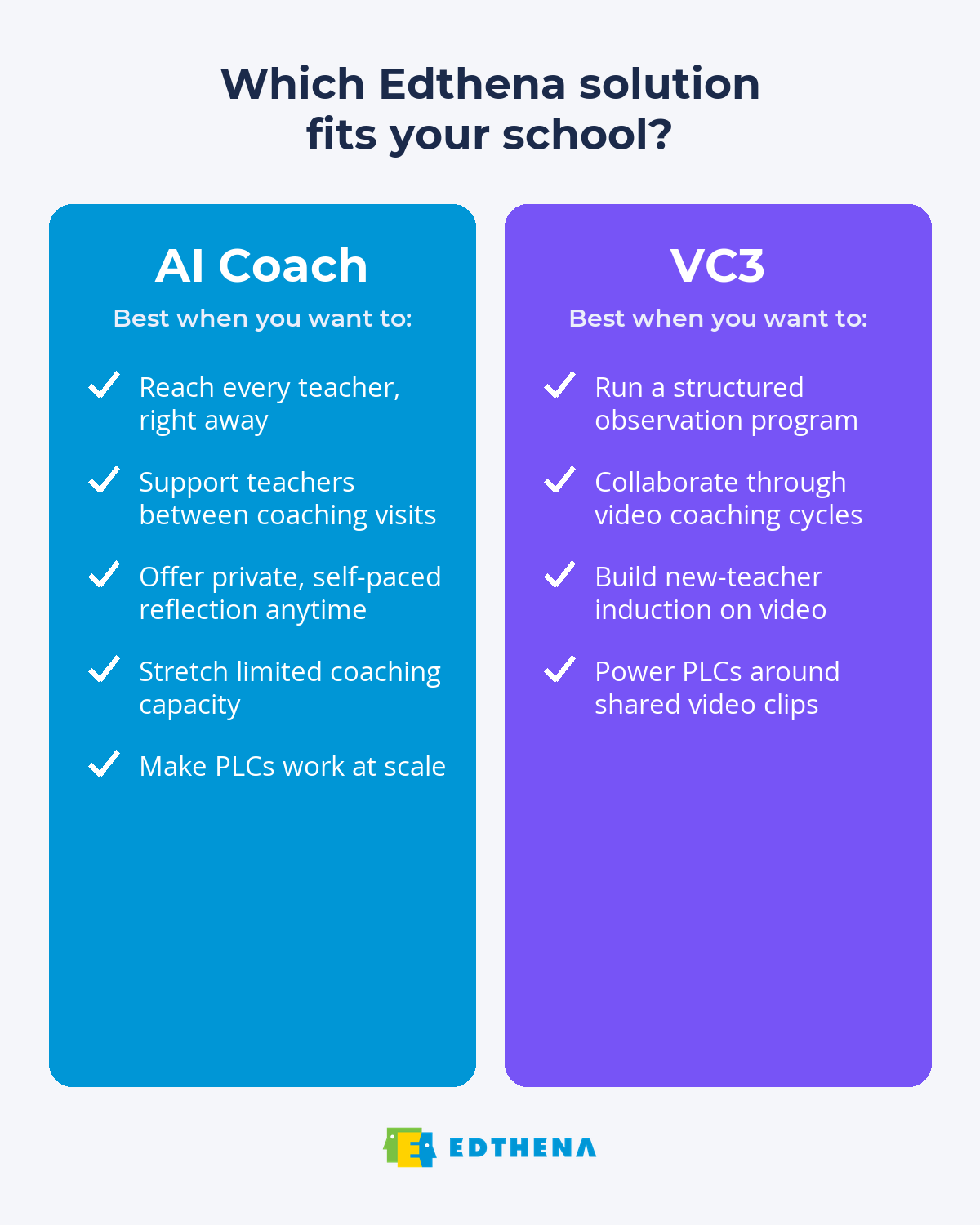
- You want every teacher to have coaching support, not just the few your coaching team can reach this semester.
- Coaching capacity is your real constraint. You have more teachers who want growth than coaches who can visit them.
- Teachers value private, judgment-free reflection they can do on their own schedule.
- You want to give teachers meaningful support between in-person coaching sessions, instead of leaving gaps.
- You run PLCs and want every team’s focus to actually change classroom practice, at scale, not just stay in the meeting.
- You want to start fast, with little setup burden on your administrators.
The point of AI Coach is reach. It amplifies your coaching capacity so that “every teacher gets coaching” stops being an aspiration and becomes how your school actually runs.
This is also what makes AI Coach a strong fit for PLCs at scale. A PLC meeting is about 45 minutes a week; the classroom is the other 34 hours. The usual gap is between what a team decides together and what changes in each member’s room, and most schools do not have enough coaches to bridge that gap for every team. AI Coach is that bridge. The team decides on a shared focus, each teacher runs an individual coaching cycle on it between meetings, and everyone returns with something concrete to discuss. We wrote more about that model in how to make PLCs actually change teaching.

What VC3 does, and who it is for
VC3 is Edthena’s video coaching platform for collaborative, human-led professional learning. Teachers record a lesson on any device, share it securely with a coach or their PLC, and colleagues add timestamped, categorized comments to help them improve. It is designed for the coaching work that happens between people: observation cycles, peer feedback, new-teacher induction, and team collaboration.
VC3 also gives that human work better tools. Auto-generated insights from the video transcript jumpstart analysis. An automatic student-to-teacher talk time chart shows the talk balance of a lesson with no hand-tallying. Coaches can anchor comments to your own frameworks and skills. And teams can pull from the Gates Foundation METx library of more than 2,100 classroom examples to kickstart learning.
VC3 is the right fit when:
- You run, or want to run, a structured program: peer observation, induction, or formal coaching cycles.
- Your PLCs want to go deeper with video: teachers bringing real lesson clips for timestamped peer feedback, not just discussion.
- Collaboration is the point. You want coaches and colleagues working through video together, not a teacher working alone.
- Video evidence matters to your program, whether for induction, micro-credentials, or documenting growth over time.
- You want leaders and coaches to facilitate professional learning with shared, timestamped, framework-aligned feedback.
The results back it up. When Arkansas Teacher Corps rolled out Edthena’s video coaching platform, first-year teacher retention rose 10 percentage points over their historical average, alongside higher coaching satisfaction and lower teacher burnout. You can read the study.
Side by side: matching the tool to the need
| If your school needs… | The better fit is… |
|---|---|
| Coaching support for every teacher, right away | AI Coach |
| To support teachers between in-person coaching visits | AI Coach |
| Private, self-paced reflection a teacher can do anytime | AI Coach |
| To stretch limited coaching capacity across more teachers | AI Coach |
| PLCs that change classroom practice at scale, with each teacher practicing the team’s focus between meetings | AI Coach |
| A structured peer observation program | VC3 |
| PLCs that collaborate around shared video clips | VC3 |
| Collaborative coaching cycles between coaches and teachers | VC3 |
| Induction and new-teacher support built on video | VC3 |
| Shared, framework-aligned feedback facilitated by a coach | VC3 |
If you read that table and found yourself nodding at rows in both columns, you are not alone. That is exactly why the two work well together.
Why many schools use both
AI Coach and VC3 are not competing answers to the same question. They cover different parts of how a school develops teachers.
AI Coach gives every teacher continuous, on-demand, completely private support, so growth keeps happening between the moments your coaches can be in the room. VC3 powers the structured, collaborative programs your leaders facilitate, where people learn from each other through video.
Run together, they close the gap that usually opens between formal coaching cycles. PLCs are where this shows up most clearly: AI Coach turns each team’s focus into individual practice between meetings across every team in the building, and VC3 brings real classroom video into the room for collaborative review. One scales the practice; the other deepens the collaboration. For leaders, the payoff is visibility: instead of seeing teacher growth in scattered snapshots, you get a continuous picture of how instruction is improving across the school.
Common questions about AI Coach and VC3
What is the difference between AI Coach and VC3?
AI Coach is a virtual instructional coach for self-guided, on-demand coaching. A teacher records a lesson, and the AI guides them through reflection, goal-setting, and an action plan, any time they want. VC3 is a video coaching platform for collaborative, human-led coaching, where teachers share lesson video with a coach or PLC for timestamped feedback. AI Coach scales coaching to every teacher; VC3 powers the collaborative programs your team runs.
Should my school start with AI Coach or VC3?
Start with AI Coach if your main constraint is reach, meaning you cannot get coaching to enough teachers and want every teacher supported quickly. Choose VC3 if you already run a structured observation, PLC, or induction program built on video collaboration. Many schools start with AI Coach and add VC3 as their program grows.
Can we use AI Coach and VC3 together?
Yes, and many districts do. AI Coach gives every teacher continuous, on-demand support between coaching visits, while VC3 powers structured, video-based collaboration. Used together, they give leaders a connected view of how teaching is improving across the school.
Which is better for PLCs?
Both have a role. AI Coach makes PLCs work at scale: each teacher runs an individual coaching cycle on the team’s shared focus between meetings, even when you do not have a coach for every team. VC3 deepens PLC collaboration by letting teachers bring real lesson clips for timestamped peer feedback.
Does AI Coach replace human coaches?
No. AI Coach is built to complement human coaches and PLCs, not replace them. It extends your coaching capacity so teachers get support between the in-person coaching sessions your team already provides.
How to decide
Start with the constraint you feel most. If the bottleneck is reach, that you simply cannot get coaching to enough teachers, begin with AI Coach. If you already have a structured program and want to make it more collaborative and evidence-based, VC3 is built for that. And if you want both reach and a strong human program, the two are designed to work side by side.
The best way to choose is to see them with your own goals in mind. Tell us what teacher growth looks like at your school right now, and we will show you which fit makes sense.
See AI Coach in action. Schedule a demo and we will walk through how it gives every teacher coaching support, fast.
Already running structured coaching, or curious how the two fit together? Talk to us about VC3.
P.S. for principals and evaluators: this post is about teacher-led growth, but the observation side counts too. Observation Copilot turns your observation notes into framework-aligned feedback in minutes, so teachers get useful feedback the same day. It works alongside either AI Coach or VC3: the feedback you give in an observation becomes the focus a teacher then works on in their coaching. See how Observation Copilot works.