How to Build Coaching Infrastructure for Your Teacher Residency Program

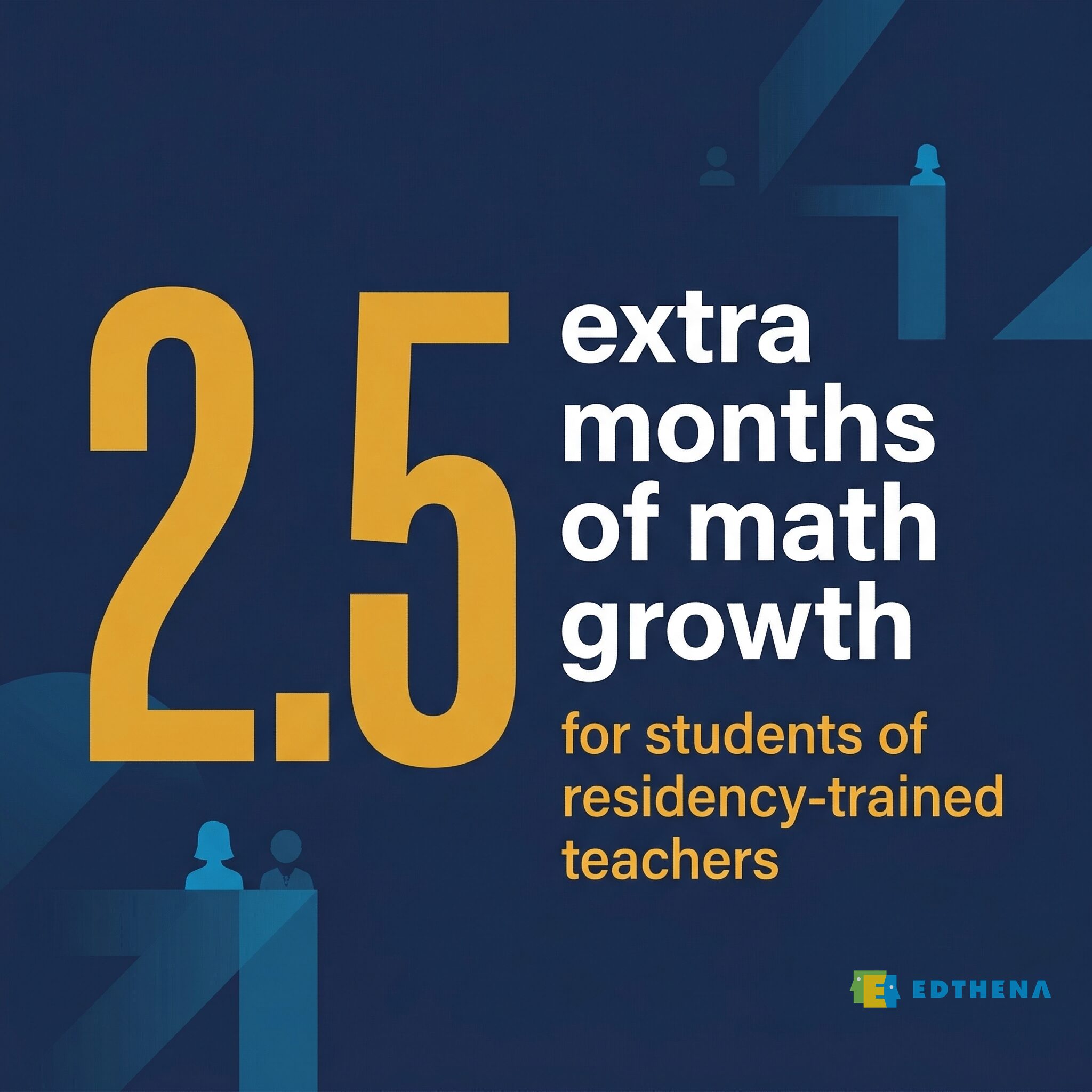
Teacher residency programs are having a moment. Federal and state funding is flowing, and states like Texas are investing up to $39,500 per residency candidate through new allotment programs. Research from the Learning Policy Institute shows why: students of residency-trained teachers gain 2.5 additional months of learning in math and three additional months in reading compared to students of average new teachers.
But funding a residency and running a good one are two different things. A yearlong clinical placement with a host teacher is a strong foundation. What turns that foundation into a program that actually produces effective teachers is the coaching infrastructure around it: the systems for feedback, reflection, and development that operate between formal observation events.
This guide is for district leaders and EPP directors who are building or scaling a teacher residency program and want to get the coaching infrastructure right from the start.
Why Coaching Infrastructure Matters More Than Program Structure
Most residency program design focuses on structure: how many clinical hours, which coursework sequence, what the host teacher’s role is, how formal observations are scheduled. Those elements matter. But they describe the container, not what happens inside it.
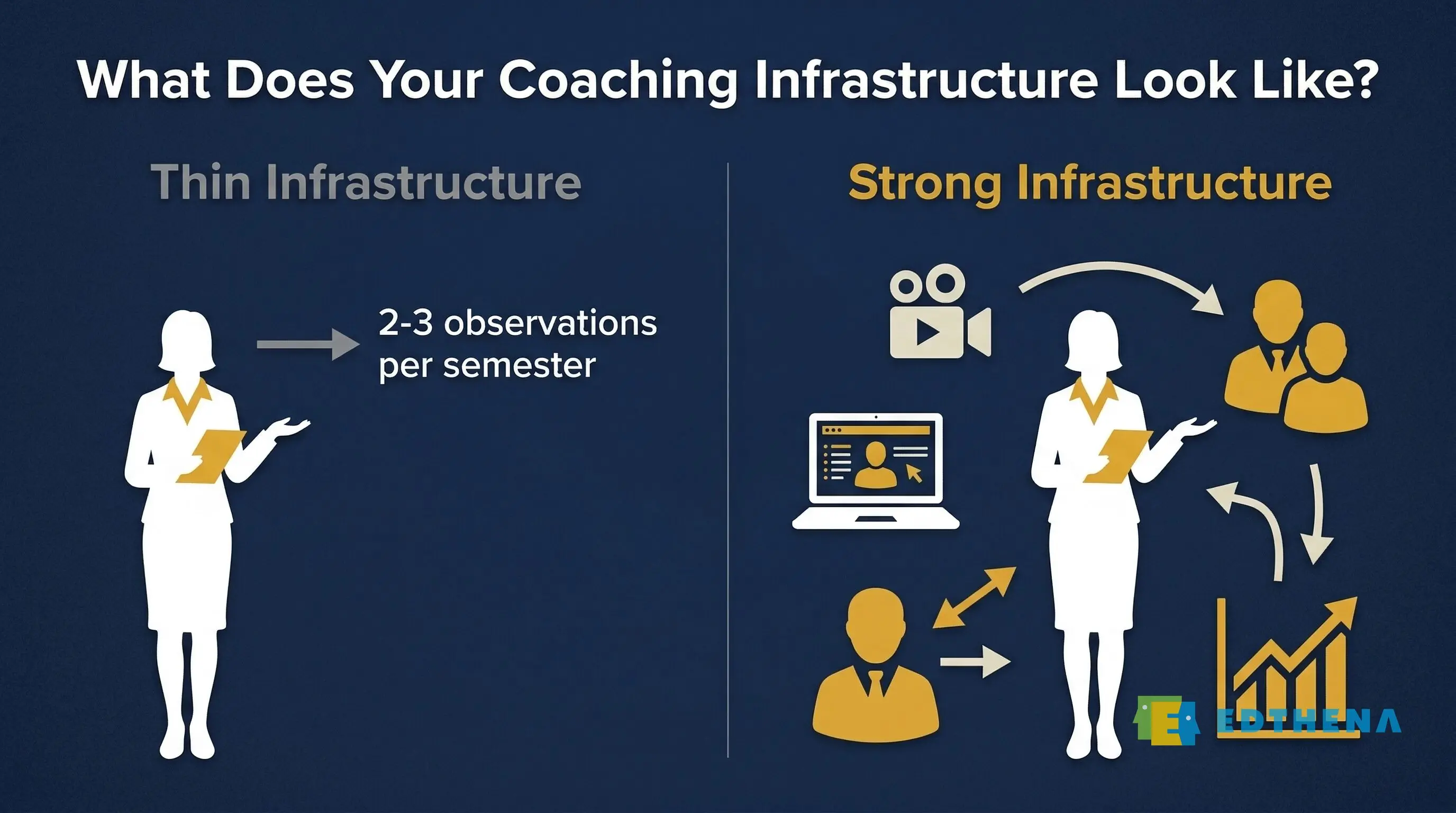
A resident’s growth happens in the daily work of teaching, not during the two or three formal observations per semester. The question is: what coaching support exists for the other 99 percent of their clinical experience?
One North Texas superintendent described the difference to the Learning Policy Institute: “It’s really a game changer to get these [teacher residents]…you don’t get a first-year teacher. You get, really, a veteran teacher.” That outcome doesn’t come from seat time alone. It comes from consistent, intentional development throughout the year.
Three Coaching Gaps in Most Residency Programs
Even well-designed residency programs tend to have three gaps in their coaching systems. These aren’t program failures. They’re structural limitations that most programs haven’t solved yet.

Gap 1: Nothing Happens Between Formal Observations
Formal observations are important. They provide structured, evaluative feedback tied to a teaching framework. But in most residency programs, the field supervisor visits two to four times per semester. The resident teaches every day. That leaves weeks of classroom practice with no consistent feedback loop.
What residents need between observations is a way to examine their own teaching, set near-term goals, and track whether changes are working. Without this, formal observation feedback arrives too late to influence the daily decisions that shape instructional practice.
Gap 2: Host Teachers Aren’t Trained as Coaches
Host teachers (also called cooperating teachers or mentor teachers) are typically selected because they’re excellent classroom practitioners. That’s the right starting point, but being a great teacher and being a great coach are different skills. Most host teachers receive minimal training on how to give developmental feedback, facilitate reflective conversations, or structure a coaching cycle.
The result: host teachers default to what they know, which is giving advice. “Try this strategy.” “You should manage transitions differently.” That’s helpful, but it’s directive, not developmental. Residents get told what to do rather than coached to figure out what to change and why.
Gap 3: Residents Don’t See Themselves Teach
Teaching is one of the few professions where practitioners rarely see themselves in action. Athletes review game film. Surgeons study recordings of procedures. But most teacher residents never watch themselves teach. They rely entirely on how it felt in the moment and what an observer tells them afterward.
Harvard’s Center for Education Policy Research developed the Best Foot Forward toolkit specifically to address this. Their research found that video observation helps teachers see patterns they can’t catch in real time: how they distribute attention across the classroom, how long they actually wait after asking a question, whether their body language matches their intent.
Building Each Layer of Coaching Infrastructure
Closing these three gaps requires three layers of coaching support, each operating on a different timescale and serving a different purpose.
Layer 1: Self-Reflection Between Observations
The highest-leverage investment is giving residents a structure for self-directed coaching between formal observation events. This means a repeatable cycle: record a lesson (or a segment of one), review it, reflect on what they see, set a goal, and plan a change for next time.
This cycle mirrors what an instructional coach does in a coaching conversation, but it happens on the resident’s schedule without requiring another person’s time. AI Coach is built for exactly this: it guides teachers through a guided self-reflection on a video of their own teaching, helps them identify a focus area, and walks them through goal-setting and action planning. For residency programs, this means every resident has access to a coaching cycle between formal visits, not just the residents lucky enough to have a highly engaged host teacher.
The privacy matters too. Residents are more willing to examine what’s not working when the reflection is private. No evaluator, no judgment, just the resident and their own teaching.
Layer 2: Video Coaching for Host Teachers and Supervisors
Host teachers and field supervisors need tools that make quality feedback easier to give, not harder. Traditional observation feedback relies on handwritten notes and memory. Video changes the dynamic in two ways.
First, it creates a shared reference point. When a host teacher and resident can watch the same two-minute clip together and discuss a specific moment, the feedback conversation becomes concrete rather than general. “When you asked that question at the 4:12 mark, notice how three students raised their hands but the rest looked away” is more useful than “you should work on engagement.”
Second, it extends the coaching relationship beyond co-located time. Field supervisors who aren’t at the school every day can review video asynchronously and leave time-stamped feedback. Pre- and post-observation conferences can happen remotely. VC3 supports this workflow: residents upload classroom video, supervisors and host teachers leave time-stamped comments, and the coaching conversation continues between visits.
The Boettcher Teacher Residency in Colorado uses this approach, combining video coaching with in-person mentoring. The video doesn’t replace the in-person relationship. It makes the relationship more productive by grounding conversations in evidence from the classroom.
Layer 3: Efficient Feedback Tools for Cooperating Teachers
Cooperating teachers who receive stipends ($2,000 per resident in many state-funded programs) have an obligation to provide quality feedback, but they’re also full-time classroom teachers. They don’t have hours to write up observation notes.
Observation Copilot helps mentor teachers and supervisors provide faster, framework-aligned feedback without the administrative burden. Instead of spending an hour after school writing up notes, they can generate quality feedback in minutes, leaving more time for the actual coaching conversation.
What the Regulations Allow
If you’re wondering whether video observation fits within your state’s regulatory framework, the answer in most cases is yes. In Texas, for example, current rules under TAC Chapter 228 explicitly allow virtual observation via “unedited electronic transmission, video, or technology-based method” for clinical teaching and internship candidates. Pre- and post-observation conferences do not need to be on-site.
For residency candidates specifically, formal observations are required to be in-person. But formal observations are a small fraction of the coaching infrastructure. Self-reflection, formative feedback, peer review, and asynchronous coaching conversations between observations are all unconstrained by in-person requirements.
A Practical Starting Checklist
If you’re building or improving a residency program, use this checklist to evaluate your coaching support systems:
- Self-reflection structure: Do residents have a way to record and review their own teaching between formal observations? Is the process structured (not just “watch yourself teach”) with guided prompts, goal-setting, and action planning?
- Host teacher coaching training: Have cooperating teachers received training on developmental feedback, not just subject-matter mentoring? Do they have tools that make giving quality feedback efficient?
- Video infrastructure: Can residents easily record classroom video? Is there a platform for sharing video with supervisors and host teachers for asynchronous feedback?
- Feedback frequency: How many feedback touchpoints does a resident get per week, including self-directed ones? If the answer is “only when the supervisor visits,” the infrastructure is thin.
- Privacy and safety: Do residents have a private space for self-reflection where they can be honest about what’s not working without it being evaluative?
- Evidence of growth: Can residents track their development over time? Is there a portfolio of coaching cycles, goals, and reflections that documents growth beyond pass/fail observation scores?
Frequently Asked Questions
How much does video coaching infrastructure cost for a residency program?
Most buildings can adopt video coaching for about $5,000 per year or less. AI-powered coaching runs about $3,450 per building. For a residency cohort of 10-40 residents, the per-resident cost of coaching infrastructure is a small fraction of the overall program investment ($24,000-$39,500 per resident in Texas PREP-funded programs).
Can video coaching count toward formal observation requirements?
It depends on your state. In Texas, virtual observation is explicitly permitted for clinical teaching and internship candidates but not for residency formal observations (which must be in-person). However, video coaching between formal observations, self-reflection, and asynchronous feedback are not regulated and can be implemented freely. Check your state’s educator preparation rules for specifics.
What if our host teachers resist video?
Start with resident self-reflection, not host teacher observation. When residents record themselves and use AI coaching privately, it normalizes video as a development tool without triggering the evaluation anxiety that makes experienced teachers uncomfortable. Once residents are sharing clips voluntarily in debrief conversations, host teachers often become curious and start engaging with the video themselves.
Do we need special equipment for classroom video recording?
No. A smartphone or tablet on a simple tripod captures enough for coaching purposes. The goal is “good enough to learn from,” not broadcast quality. Many programs start with a $200 recording kit: a phone mount, a basic tripod, and a wireless microphone for audio clarity.
Teacher residency programs represent the highest-quality pathway into the profession. The investment in clinical time, mentoring, and structured preparation is significant. The coaching and development systems around the residency are what ensure that investment produces teachers who are genuinely ready for the classroom, not just credentialed. The tools exist. The research supports them. The gap is in building the systems that put them to work.
Ready to build coaching infrastructure for your residency program? Contact Edthena to learn how AI Coach, VC3, and Observation Copilot can support your residents, host teachers, and supervisors.